
Imagine the days before that first large language model (LLM) launched. Back then, automation made business processes fully deterministic: you wrote them in code and clearly defined the steps and outcomes. With the advent of reasoning models, the world shifted completely. Adding a reasoning layer meant your agentic applications could interpret intent and adapt on the fly instead of failing at the first unexpected input. But this shift created a new problem: a lack of visibility and predictability.
Not every business process needs full LLM reasoning at every step. Most processes live somewhere in the middle: some parts should run predictably every time, and some parts should benefit from an agent deciding what comes next. With the newest enhancements to Agent Broker, you can both add deterministic logic for more granular control over your agentic workflows and introduce reasoning models where you want additional intelligence.
What is guided determinism?
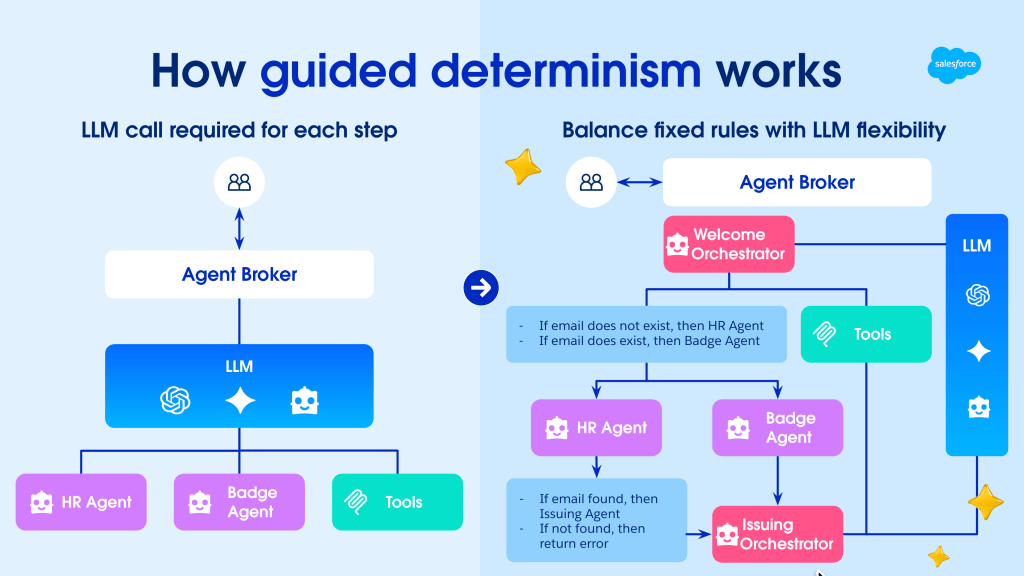
The first version of Agent Broker is fully agentic. The LLM reasons through every step, which means it can handle complex, unpredictable scenarios with remarkable flexibility. The tradeoff is that every step requires a model call, which increases token usage and latency and results in varied outcomes between runs.
The Broker has evolved and now supports guided determinism. Let’s say you’re authoring an IT support investigation workflow that requires 100% certainty. Now, you can create a defined path for escalation into the process. You still use LLM reasoning models in your workflow, but you’re using them for tasks they’re good at, like research and analysis.
Guided determinism also helps manage your token usage and processing latency. Instead of relying on an LLM to do simple routing, like if/then statements, you can hard-code those statements into the Broker without the need for an LLM call, saving both time and token consumption. You can also configure which LLMs handle specific scenarios in your flow. For example, if your workflow has a simple summarization component, you can use a smaller, cheaper, and faster model. If the workflow has a complex component, you can use a larger, more powerful model to meet that need. Our internal benchmarks found that guided determinism can reduce end-to-end latency by over 50% and LLM calls by over 30%.
How Agent Script enables guided determinism
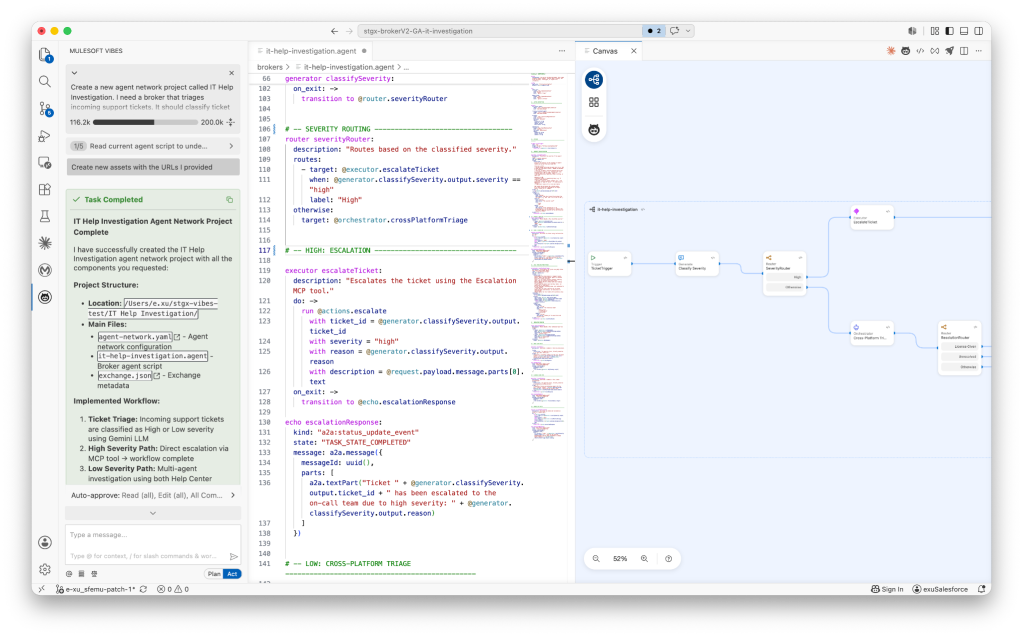
You can now author the logic for Agent Broker’s guided determinism using a dialect of Agent Script, a powerful, open source language that blends AI reasoning with structured rules. Agent Script supports advanced features, such as structured output, variables, prompt building, and routing. You can choose between different node types to control your AI workflow, and you can orchestrate Agent-to-Agent (A2A) agents and MCP tools.
If you’ve ever used Agent Script to build Agentforce agents, you’ll feel right at home with its familiar syntax. You author your Agent Network and Broker in the Anypoint Code Builder, and you can see your agent workflow graph Broker in real-time as you work through each step. You can also use MuleSoft Vibes to author your Broker – prompting it and following its feedback from initial idea to complete workflow. If you prefer an alternative coding agent, check out the skills on MuleSoft’s new Dev Portal.
Learn more about how Agent Script builds deterministic control in Enterprise AI workflows.
Enterprise use cases for guided determinism
These new capabilities have been in beta for the past month and during this period, we’ve seen a number of customers build some amazing use cases. With guided determinism, enterprises are building agent orchestrations based on control and are getting the peace of mind they need to move their AI initiatives from a proof-of-concept to production.
“Agent Broker allowed our team to focus on solving business problems rather than learning a new framework. Because it builds on concepts we already know from Agentforce and Agent Script, we were able to get started quickly and apply it to real-world scenarios. We’re currently exploring how Agent Broker can orchestrate interactions across systems and tools to support more scalable agentic workflows.”
– John Pettifor, SVP of Innovation, Diabsolut
Customer use cases
Check out these examples inspired by real use cases from our customers.
Support and Investigation Broker
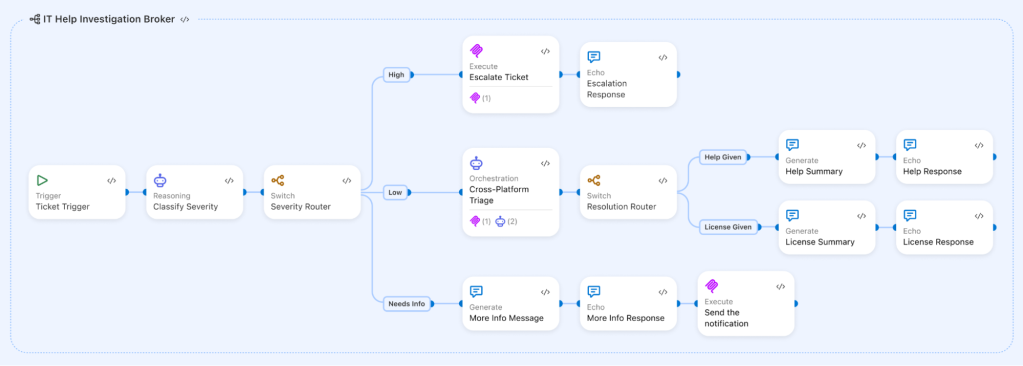
Let’s say you’re an IT support team leader and want to build a broker to investigate and resolve support tickets. Some tickets can be high severity; for example, a user finds unauthorized login attempts on their account. You’ll want to deterministically route such high-severity issues to the on-call team immediately.
However, most tickets are low severity, so you’ll want to leverage the power of LLM reasoning and tools, such as a Help Center Agent and License Provisioning Agent to investigate the root cause and provide a resolution. That’s the power of guided determinism: it allows you to define business critical parts of your flow with deterministic logic, while using the full power of AI intelligence when it’s safe and allowed to do so.
Intent Routing Broker
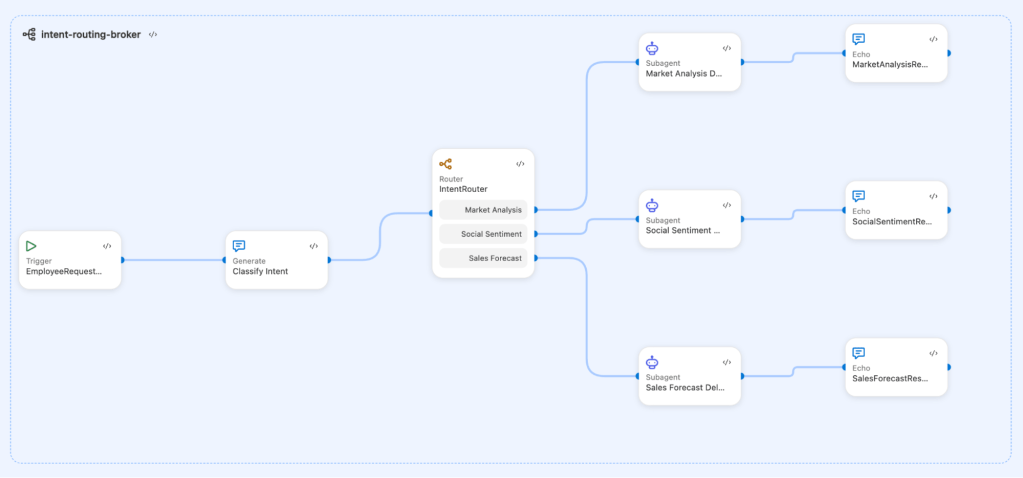
Imagine you lead a platform team that has many employee-facing agents spread across platforms. Each agent serves a different use case (e.g. a market analysis agent on LangSmith, a social media sentiment analysis agent by a third party vendor, and others). Your employees, however, are struggling to find the correct agent for their question. To solve this dilemma, you author a broker to orchestrate these disparate agents.
Now, when a query comes in, the broker quickly and accurately identifies the user’s intent and routes the request to the relevant agent. Your Broker allows you to use LLM reasoning to semantically identify a user’s intent, and then deterministically route the user to the correct agent.
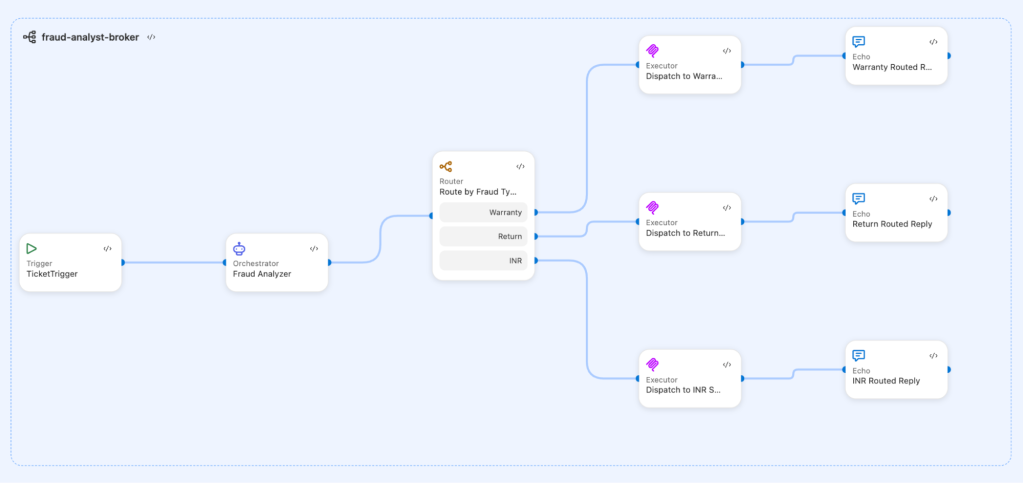
Fraud Analyst Broker
In this example, you’re the Head of Fraud at a large online merchant. You want to use AI to analyze post-sales service tickets to catch fraud attempts and flag fraudulent customer accounts. Because service tickets contain many historical customer interactions and nuanced signals, you need to use the power of LLM reasoning models to analyze this information and orchestrate fraud tools to determine a risk score and rationale and classify the type of fraud.
But you don’t want to rely solely on the LLM’s judgement to make a determination on a customer’s account. So you author a Broker that can deterministically route each case by its fraud type to the right expert specialist (warranty fraud, return fraud, item-not-received fraud) who analyzes the account and makes the final classification on the customer’s account.
Ready to give it a try?
Agent Fabric already helps you discover and govern your agents and MCP tools. And now, with the latest release of Agent Broker, you can orchestrate them with deterministic control. To get started, check out Building Agent Networks for Agent Fabric in the MuleSoft documentation. You’ll find everything you need to get started, including a Agent Script file reference and a full working example. If you’re ready to dive in, you can jump straight into Anypoint Code Builder and get started right away.
To learn more, watch the demo video for a firsthand view:


