
A practitioner’s view on Anypoint Omni Gateway as the connective tissue between internal applications, not just the public-facing API edge.
Ask most architects to draw where an API gateway sits in their landscape. The picture is familiar: developers and partners on one side, the gateway at the network edge, services behind it. This canonical “front door” view dominates the tutorials. It also understates the role Omni Gateway can play.
In enterprise modernization work, the highest-leverage application of Omni Gateway has had little to do with developer-facing APIs. The deeper value appears in the middle of the application network: securing and governing machine-to-machine (M2M) traffic between existing internal systems, including legacy non-Mule applications no organization has the appetite to rewrite.
The same gateway, the same control plane, and the same policy set can serve a second purpose. Deployed in the middle, Omni Gateway becomes the standard governed conduit for app-to-app traffic across the estate. That reframing changes the modernization roadmap in meaningful ways.
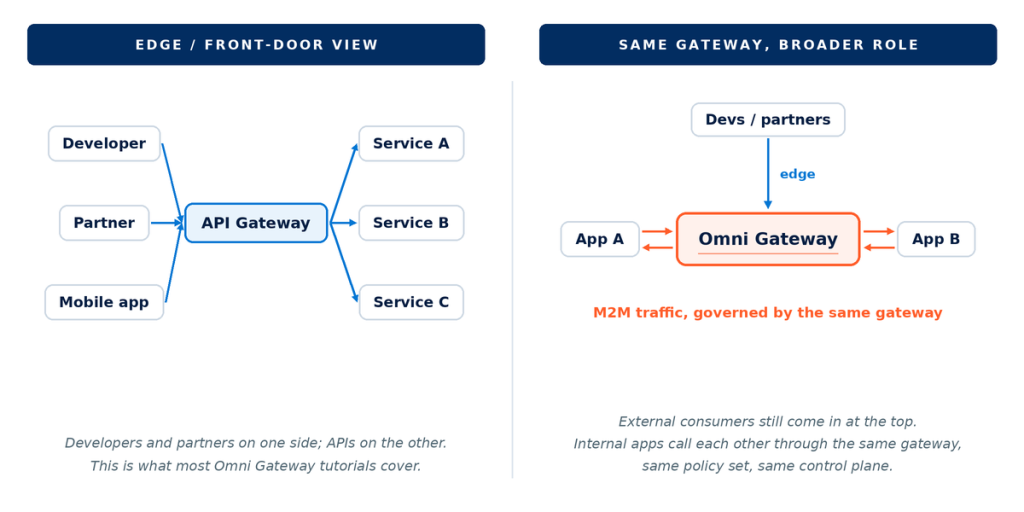
Figure 1. Omni Gateway plays two roles. The familiar role is edge gateway for developer and partner APIs. The broader role is governed conduit for traffic between internal applications. Same gateway, same control plane, same policy set.
The misconception worth fixing
Most teams deploy Omni Gateway to expose Experience APIs to the outside world. The gateway is well-suited to that role. The more useful question is how internal applications call each other today. In most enterprises, the inventory is uncomfortable:
- Point-to-point HTTP calls with hard-coded URLs and shared service accounts.
- Apache or NGINX reverse proxies on the ingress segment performing little more than IP allowlisting and downstream forwarding.
- Legacy API gateways no one wants to touch because migrating consumers is expensive.
- Inconsistent identity integration across applications.
This is not a security posture. It is a collection of habits. The pattern persists because the obvious modernization path, “put a real API in front of everything,” implies rewriting working applications as Mule integrations or standalone services. For stable systems, that approach is not viable.
Omni Gateway eliminates the rewrite requirement. As an Envoy-based data plane that fronts any HTTP endpoint, Mule or non-Mule, on-premises or cloud, it delivers authentication, contracts, rate limiting, URL rewriting, analytics, and audit the moment it sits in front of a legacy application. The application changes nothing.
That single property, the gateway is happy to front whatever you have, is what elevates Omni Gateway from a front door into a general-purpose M2M mediator.
Pattern 1: standalone reverse proxy
The simplest expression of the idea is the most useful. Stand up Omni Gateway in front of an existing application. Publish an OAS 3.0 definition in Anypoint Exchange where the upstream is the application’s HTTP endpoint. Attach the policies: OAuth 2.0 / JWT validation, client contracts, rate limiting, IP allowlists, URL rewrite, audit logging. Point consumer applications at the gateway through a branded vanity DNS such as api.example.com.
The consuming application obtains a token from the identity provider using the client credentials grant, presents the JWT to the gateway, and the gateway validates it against the IdP’s JWKS endpoint before forwarding to the upstream. Modern, governed API behavior, with no changes to the upstream.
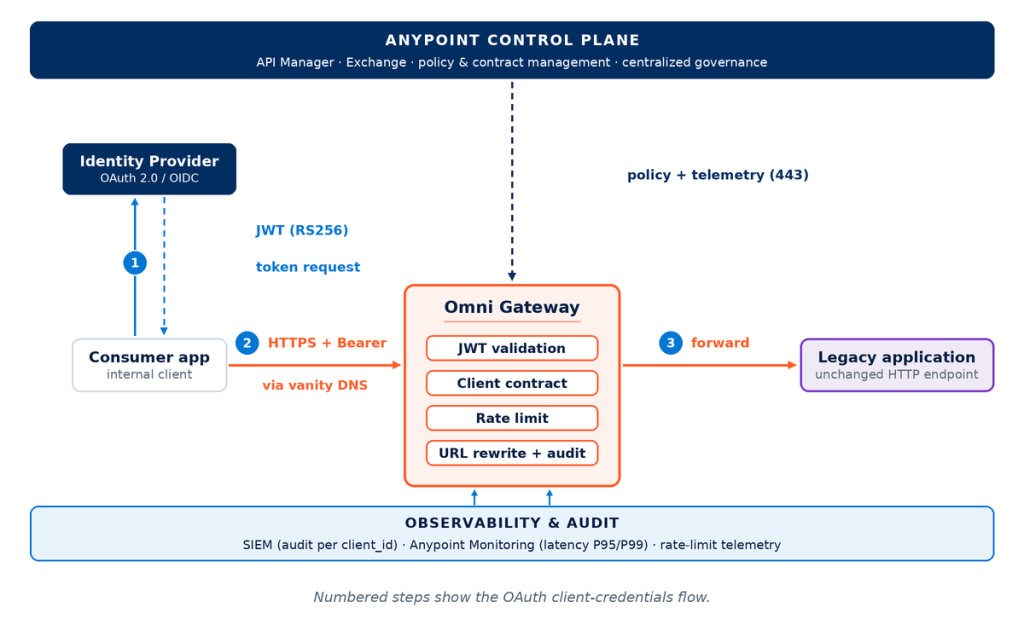
Figure 2. Pattern 1 in detail. The consumer obtains an OAuth client credentials token from the identity provider (step 1), presents it to Omni Gateway as a Bearer token (step 2), and the gateway forwards the validated request to the legacy upstream (step 3). Anypoint manages policy and audit centrally above; observability sinks below.
Often overlooked is how much existing infrastructure this pattern absorbs. The Apache reverse proxy typical on the ingress segment performs inbound IP allowlisting and downstream forwarding, nothing more. It has no awareness of identity, no client contracts, no rate limits, no meaningful observability. The Omni Gateway IP-allowlist policy subsumes that function and adds everything Apache never did. One in-place swap retires a category of legacy infrastructure.
Pattern 2: auth translation
Many internal applications were built when authentication meant Basic Auth, a SiteMinder cookie, a custom header, or internal mTLS. Putting a modern OAuth client in front of them requires translating between two worlds.
This is where the Omni Gateway policy model earns its keep. The gateway validates the modern OAuth token on the inbound leg. On the outbound leg between the gateway and the application, it injects the credential the upstream expects. Static credentials use the included Credential Injection policy. Dynamic credentials and handshake-style authentication use a custom Policy Development Kit (PDK) policy in Rust, compiled to WebAssembly. PDK provides async/await ergonomics over the Envoy SDK, supports outbound HTTP calls and shared state, and accepts third-party libraries. The surface is sufficient for most authentication schemes encountered in practice.
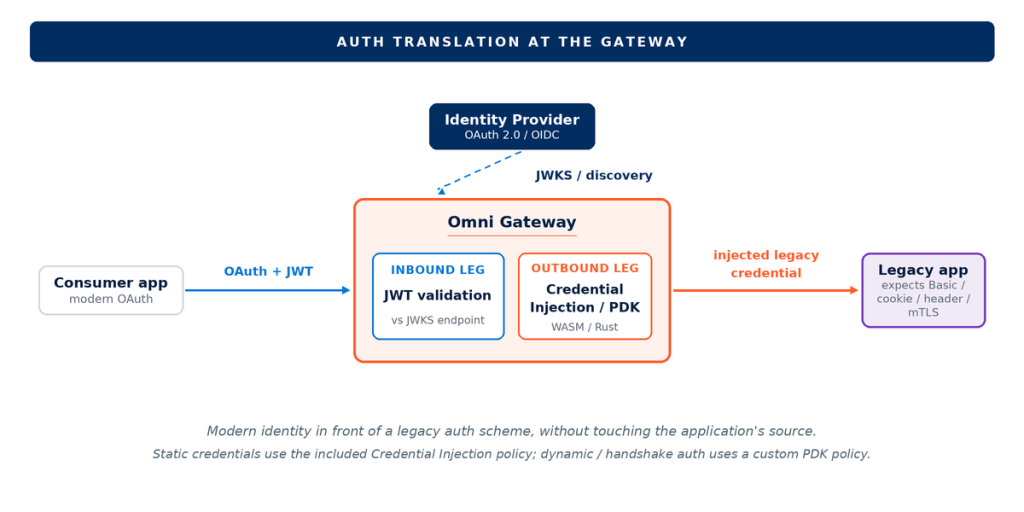
Figure 3. Auth translation in a single hop. The gateway validates the modern OAuth token on the inbound leg and injects the credential the legacy upstream expects on the outbound leg: Basic, a cookie, a custom header, or an mTLS handshake. Static schemes use the Credential Injection policy; dynamic schemes use a custom PDK policy.
The implication matters. A centralized identity layer can be placed in front of an application that has none, or has the wrong one, without touching the application’s source. That is the difference between a year-long modernization project and a two-week one.
Replacing a legacy gateway in place
A common enterprise scenario: an aging API gateway, sometimes a commercial product with a winding-down vendor relationship, sometimes a homegrown stack no one wants to operate. The consumers are stable. The backends are stable. Only the gateway itself is the problem.
Omni Gateway slides into the role without changing either side. URL rewrite preserves the legacy path conventions consumers expect. The old client registry maps to API Manager contracts. The old identity integration, whether SiteMinder, a self-hosted OAuth provider, or something else, points to the strategic IdP.
A practical note on transition strategy. If migrating all consumers to a new identity provider on day one is impractical, an existing OAuth toolkit (OTK) already deployed for another internal service can serve as a temporary bridge. The gateway validates tokens from the existing OTK while consumer teams migrate to the strategic IdP on their own schedules. The option matters when the gateway cutover must land before the identity migration completes.
Replacement is not the only path. Sometimes the legacy gateway cannot be retired on the timeline anyone would choose: a vendor contract still has years to run, consumers cannot repoint yet, or the cutover risk is unacceptable this quarter. Gateway Federation covers that case. Federation matters when governance cannot wait for the migration to finish.
The public-edge variation
For traffic that crosses the public internet (partners, mobile, external integrations), the same Omni Gateway sits behind a CDN. The CDN handles TLS termination, WAF and DDoS protection, geographic distribution, and mTLS to the gateway origin. The gateway enforces the same OAuth, contract, and rate-limit policy set used for internal traffic. The legacy upstream never sees the public internet.
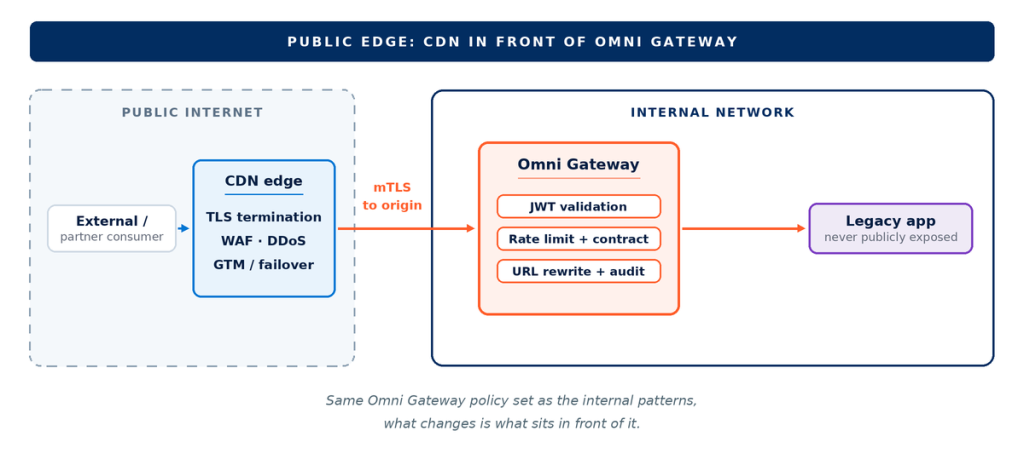
Figure 4. External-facing variation. A CDN handles TLS termination, WAF, and DDoS protection at the public edge, then mutual TLS to the gateway origin. The Omni Gateway policy set is unchanged from the internal case; the legacy upstream never sees the public internet.
The architectural point is that the policy set does not change between internal and external use cases. What changes is what sits in front of the gateway. Teams learn one policy model and apply it everywhere.
Two deployment modes
Omni Gateway operates in two modes.
In Connected mode, the gateway is deployed on customer infrastructure as a Linux service, Docker container, or Kubernetes pod. It dials out to the Anypoint control plane over HTTPS/443 to pull policy and push telemetry, but the runtime plane remains customer-owned. The constraints of CloudHub 2.0 Fully Managed (no kubectl, no Anypoint Secrets Manager, no Fluent Bit YAML, no managed auto-scaling) do not apply. Full control of the runtime makes Connected mode the natural fit for in-place reverse-proxy replacement: position the gateway exactly where the Apache box lives today, and the upstream call stays local.
In Fully Managed mode, MuleSoft operates the gateway on CloudHub 2.0. The team gets a dashboard, automated deployment, and zero operational burden. The trade-off is twofold: the fully managed runtime carries its constraints, and the gateway resides in MuleSoft’s cloud rather than the customer data center. Fully Managed is well-suited to fronting APIs that already live in the cloud, or to teams seeking minimum operational overhead. To front an arbitrary on-premises upstream from a managed cloud gateway, also factor in the private-connectivity requirement on the gateway-to-upstream leg, and validate the specifics with the MuleSoft account team.
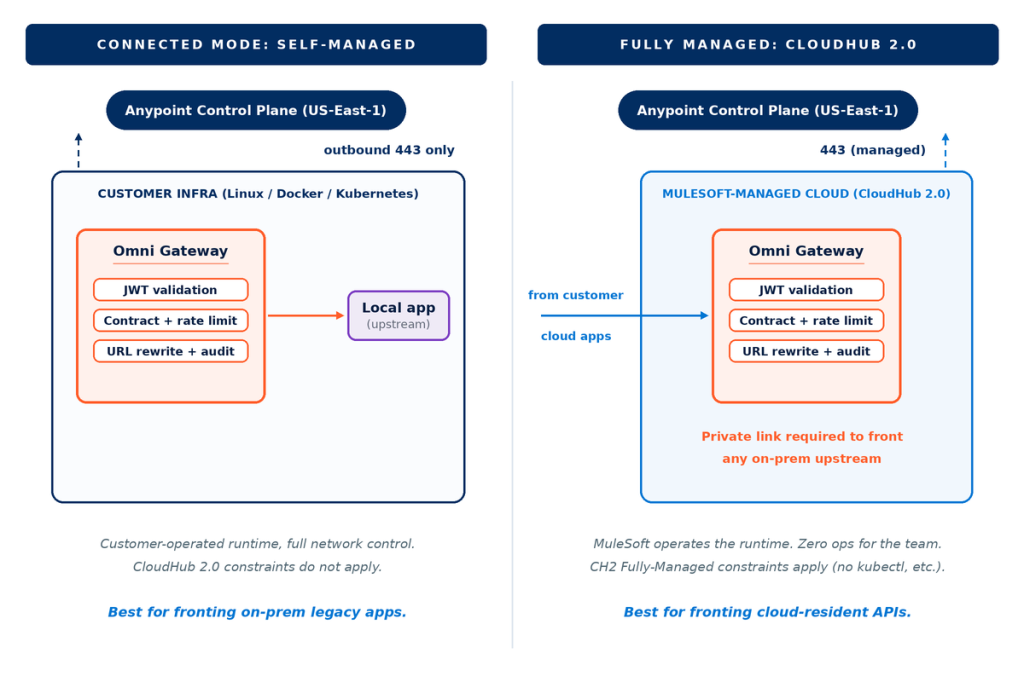
Figure 5. Omni Gateway runs in two modes. Connected mode deploys the gateway on infrastructure the customer operates, co-located with the application for a local upstream hop. Fully Managed mode hands the runtime to MuleSoft on CloudHub 2.0, well suited to fronting cloud-resident APIs. Both modes share one control plane and one policy model.
A practical rule of thumb: self-managed Connected mode fits on-premises legacy applications, because the gateway co-locates with the application and the call stays inside the boundary. Fully Managed fits the surface fronting cloud-resident APIs, because operational burden is minimal and the gateway is already in the right network position. Most estates need both. They share the same control plane and the same policy set.
The security conversation
One concern surfaces consistently and deserves a direct answer. Does placing a gateway in front of a legacy application meaningfully obscure the upstream from a security perspective? Only if the gateway-to-upstream leg is appropriately controlled.
When the gateway co-locates with the application (Connected mode in the same data center), the upstream call is a local hop and the obfuscation is real. When the gateway sits in a different network, for example a managed cloud gateway fronting an on-premises application, the gateway-to-upstream leg should ride a private circuit (Direct Connect, ExpressRoute, or equivalent). Without that, security teams correctly treat URL rewrite as a labeling exercise rather than true obfuscation. Raise this with security and networking teams early. It is a design input, not a blocker.
What this delivers
With Omni Gateway in front of internal applications, the organization gains a consistent authentication model for every consumer, typically OAuth 2.0 client credentials, regardless of how the underlying applications were originally built. Centralized client contracts and SLA tiers live in API Manager with the governance and lifecycle treatment of a public API product. Rate limiting and IP allowlisting move to the edge, ahead of any application resource consumption. URL rewriting and branded vanity DNS give consumers clean, stable endpoints regardless of where the upstream lives. A complete audit trail per client_id feeds the standardized SIEM and observability stack. And the consolidation opportunity is real: Apache and NGINX boxes performing allowlist-and-forward duties retire in favor of a gateway that does that and considerably more.
What the organization avoids: rewriting the underlying applications, changing their authentication schemes, or migrating their consumers on day one. That separation of concerns is the entire point.
Where this fits the roadmap
Organizations already running Omni Gateway as their API edge have what is needed: runtime, control plane, policy set, operational muscle memory. The work that remains is discovery and inventory. Which internal communications are unmanaged today? Which sit behind aging gateways or hand-rolled reverse proxies? Which would benefit most from being pulled into the same governed pattern?
A sensible sequencing: begin with upstreams most exposed in audits or compliance reviews. Add upstreams currently fronted by legacy gateways whose vendor relationships are ending. Sweep the long tail of point-to-point connections one at a time. Each is a small project. Each moves the estate closer to a single governed, observable application network, and to the simpler operational story that follows.
Omni Gateway has always been positioned as the gateway for any API, AI, MCP and agent, anywhere. The phrase deserves a concrete reading. “Anywhere” includes the middle of the application network, between the applications already in production. Treated that way, the value extends well beyond the front door.
This post reflects field experience across enterprise modernization engagements. The patterns are vendor-agnostic with respect to identity providers, CDNs, and reverse-proxy products mentioned by category. Validate specific deployment, networking, and security choices with the MuleSoft account team and the internal security organization.


