
The governance challenge of agentic AI is not primarily a model problem or an agent-building problem. It is an integration and operations problem. When agents reason and act, what breaks down is the layer responsible for answering the questions the agent runtime was never designed to answer: who authorized this agent to call this tool? Has it exceeded its token budget? Does the credential it is presenting belong to the human whose task it is executing? Did it send sensitive data to a model endpoint it was not cleared to reach?
That layer is the control plane. In networking, the control plane is the part of the system that decides how traffic should be handled; the data plane is what actually moves it. The same separation applies to agent infrastructure. The agent runtime – Agentforce, Bedrock, a custom orchestration script, LangGraph – is the execution layer. It reasons, plans, and calls tools. The agent control plane is the governance layer that sits above and across those runtimes. It governs agents, MCP servers, model endpoints, APIs, and data connectors as first-class assets, applying policy, enforcing identity constraints, metering cost, and maintaining an audit record, independent of which runtime those assets are called from. The runtime does not know and does not care about governance. The control plane exists precisely because it must.
Right now, most enterprises start by adding vendor-specific governance on top of each agent platform they adopt, because that path is fast and bundled. That produces governance sprawl: a different dashboard, a different policy model, and a different identity framework for every AI vendor in the portfolio. The shortcut works in pilots and fails at scale.
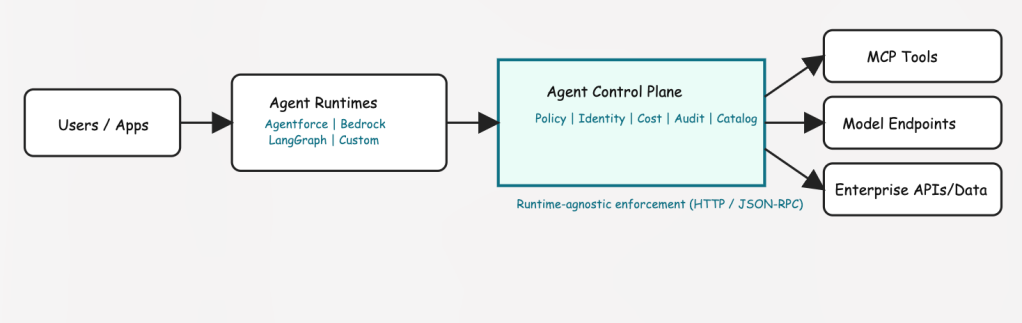
The decision, then, is not abstract: do you rent governance from each runtime vendor, or do you own governance as a portable enterprise capability? The sections below are not principles or best practices. They are the design gates. If a platform fails a gate, it is not an enterprise control plane for your use case.
The Invisible Tax
Hyperscalers, SaaS vendors and AI labs all offer agent observability, model guardrails, and policy tooling bundled into their AI platform subscriptions. On the face of it they appear free, or cheap, but the invisible tax surfaces when you need to move.
Governance expressed in native cloud constructs — AWS IAM policies for Bedrock, Azure RBAC for Copilot Studio, GCP workload identity for Vertex AI – is non-transferable. Every policy definition, every audit configuration, every rate limit rule is authored in a proprietary schema that only has meaning inside that cloud. A multi-cloud portfolio running agents across two hyperscalers requires two separate governance stacks, written in two policy languages, audited through two dashboards, with no unified view across either.
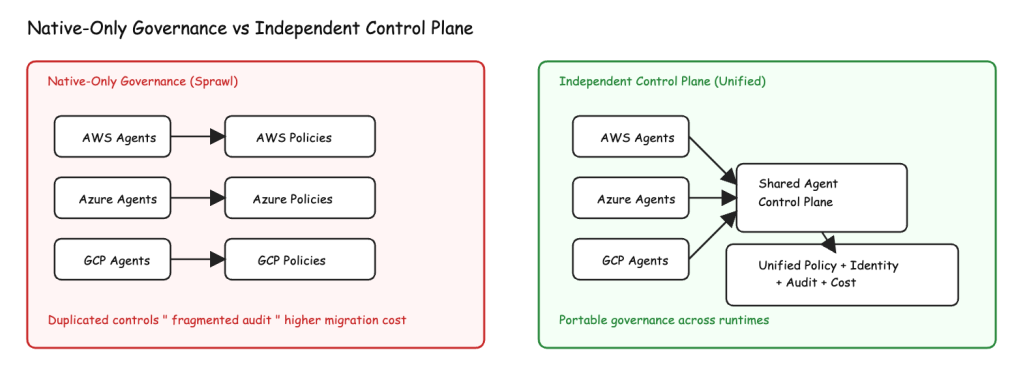
When a compliance requirement, a cost optimization, or a vendor renegotiation forces you to move workloads, the governance rebuild is the cost you discover too late to factor into the original decision. The tooling that appeared free at signup becomes the lock-in mechanism at exit. The cloud vendor was renting you governance, not selling it.
The answer to governance sprawl, perimeter fragility, and the hyperscaler governance tax is the same architecture: an asset-aware control plane. One that governs by what the asset is – agent, MCP server, model, API, data connector – rather than by who built it or which cloud it runs on. That is how API governance matured over the past decade. It is the pattern enterprise-grade agent governance will follow. The design gates below are a framework for evaluating whether a given control plane actually delivers it – operationally, economically, and under failure conditions.
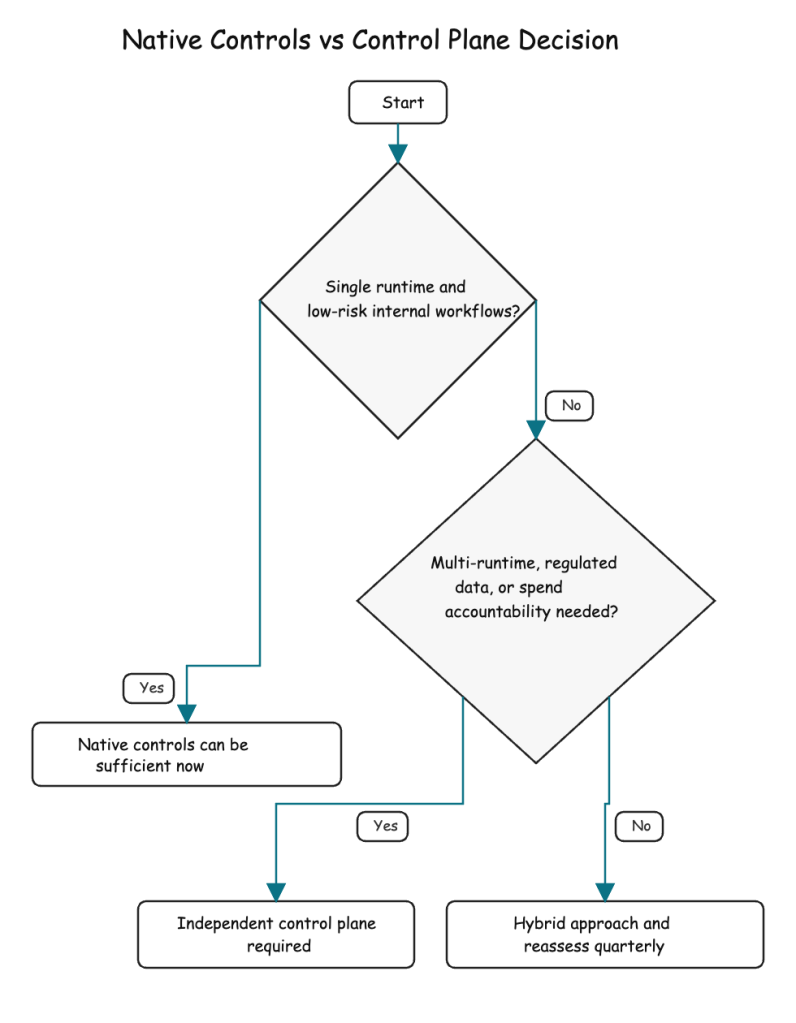
When Native Controls Are Enough and When They Fail
Native runtime controls are often sufficient when one runtime dominates, use cases are low-risk, and regulatory exposure is limited. In that context, local optimization can outperform cross-platform standardization. They fail when portfolio reality changes: multiple runtimes, cross-boundary data access, distributed identity domains, and rising model spend. At that point, governance overhead scales faster than business value unless controls are centralized around assets rather than runtimes. This is the decision boundary executives should force early: is your current architecture optimized for pilot speed, or for production governance at scale?
Quantifying the Invisible Tax
The governance tax is not conceptual. It is measurable across duplication, disruption, and spend drift. First, duplication: per-runtime policy authoring, testing, identity mapping, and audit evidence collection create recurring control operations cost. Second, disruption: fragmented governance increases incident and outage handling costs. A practical two-year TCO lens is therefore: Total governance cost = duplicated control operations + cross-runtime audit reconciliation + avoidable spend variance + disruption exposure. An independent control plane does not remove all four components. It changes the cost curve from per-runtime duplication to shared control leverage.
What a Credible Control Plane Governs
A credible control plane governs agents, MCP servers, model endpoints, APIs, and data connectors as first-class assets by applying policy, enforcing identity constraints, metering cost, and maintaining an audit record independent of which runtime those assets are called from. The architecture that makes this possible is the same separation that made network infrastructure reliable: a control plane that decides how traffic is handled, and a data plane (the runtime) that moves it.
The runtime does not know and does not care about governance. The control plane exists precisely because it must.
Design Gates for Architecting an Agent Control Plane
Design Gate I: Enforcement Neutrality at the Transport Layer
An agent control plane must apply identical governance policies regardless of which vendor built the agent, which model it uses, or which orchestration framework it runs on. That neutrality must be structural — enforced at the transport layer — not asserted through configuration.
Every major cloud provider’s AI governance capability has an obvious blind spot: it governs agents native to that cloud with full fidelity, and treats agents from other platforms as second-class citizens requiring adapter layers and partial observability. The architecture that produces this blind spot is governance that lives inside the runtime rather than at the transport layer between runtimes.
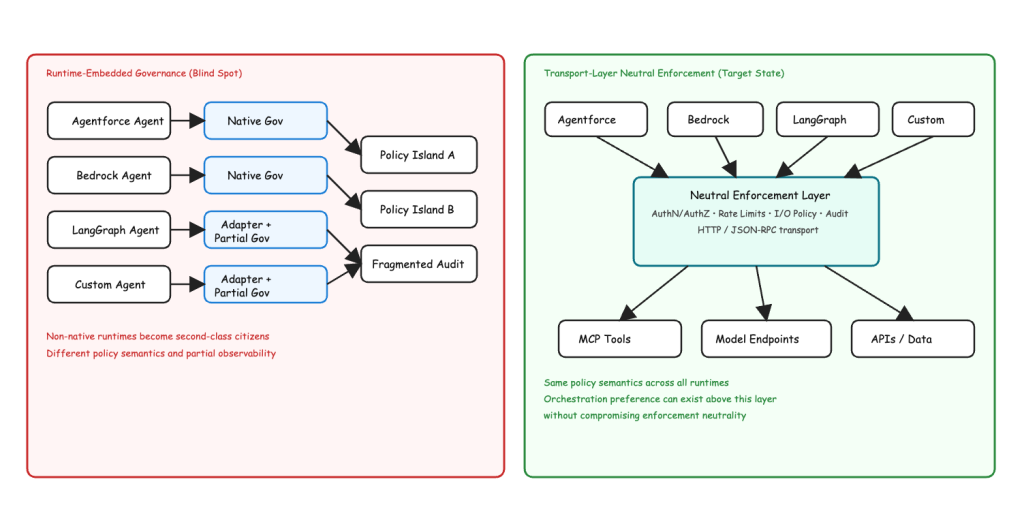
A structurally neutral control plane works at the transport layer such as HTTP. It enforces policies on traffic between agents and the tools, models, and data they call — not on a specific agent framework or SDK. An agent built on LangGraph, in Agentforce, a Bedrock agent, and a custom Python script all look identical at the HTTP transport layer: they are callers of tools and models exposed as HTTP endpoints. At that layer, the same rate limiting, authentication validation, input and output filtering, and audit logging applies to all of them.
However one clarification worth naming directly is enforcement-layer neutrality is not the same as zero orchestration preference. A multi-agent orchestration component can have native alignment with one platform without compromising enforcement guarantees — those operate at different layers. The test is not whether the vendor has native integrations with preferred platforms. Every governance vendor does. The gate is whether the enforcement layer applies identical policy to agents the vendor did not build.
The emergence of Model Context Protocol (MCP) as an HTTP-based tool-calling standard, and A2A Protocol as an agent-to-agent communication standard, provides the transport surface that neutral enforcement attaches to. Because both protocols use HTTP with JSON-RPC, existing HTTP enforcement infrastructure applies immediately without modification.
Design Gate II: Policy Attached to the Asset, Not the Perimeter
Governance that lives at the network perimeter is fragile. Governance that attaches to the asset — the individual agent, MCP server, model endpoint, or API — survives agent migration, infrastructure changes, and multi-cloud deployments without policy drift.
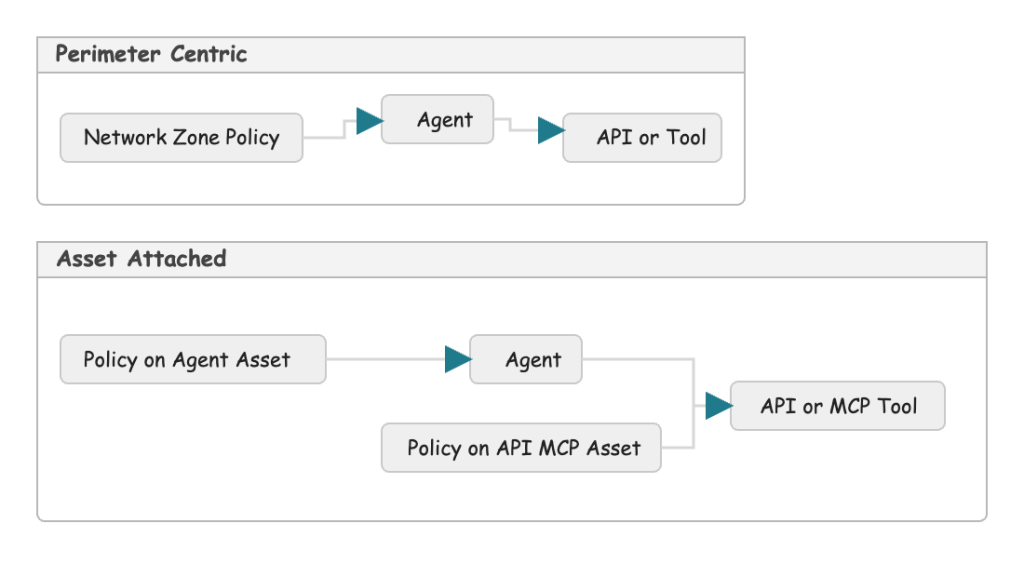
The dominant security pattern of the last two decades — enforce at the perimeter, trust inside — fails in agentic architectures for a specific structural reason: agents are designed to work across perimeters. An enterprise agent calling a supplier’s API, accessing a cloud data lake, and writing to a SaaS CRM is crossing perimeter boundaries with every task step. A firewall rule governing the subnet tells you nothing about the authorization scope of the agent inside it.
Asset-attached governance binds policy to the governed resource rather than to its network location. The authentication requirement for an MCP tool lives with that tool’s registration in the catalog, not with a firewall rule for the subnet where it runs. When the tool migrates to a different environment, moves from AWS to Azure, or gets an additional deployment, the policy travels with it. No human recreates network rules. No policy drifts during the migration window.
This pattern is already familiar to API governance practitioners – assigning rate limits, authentication requirements, and SLA tiers to API assets rather than to the network topology around them. The same model, extended to MCP servers, model endpoints, and agent registrations, applies proven governance to the new agentic surface area without inventing new mechanisms.
There is a secondary benefit worth naming: asset-attached governance provides a detection surface for ungoverned agents. An agent that bypasses the enforcement layer appears in the catalog as an ungoverned asset — discoverable, flaggable, and subject to remediation. A perimeter-based system cannot detect agents operating inside the perimeter without going through the governance layer, which is precisely where shadow agent risk lives.
Gate test: if policy must be rewritten during asset migration, the platform fails this gate.
Design Gate III: Enforcement Anywhere, Management at Cloud Scale
The enforcement layer must be deployable wherever agents operate — cloud-managed, customer VPC, Kubernetes sidecar, on-premises hardware. The management plane that configures that enforcement can and may be cloud-hosted. The policy execution and enforcement must be infrastructure-independent.
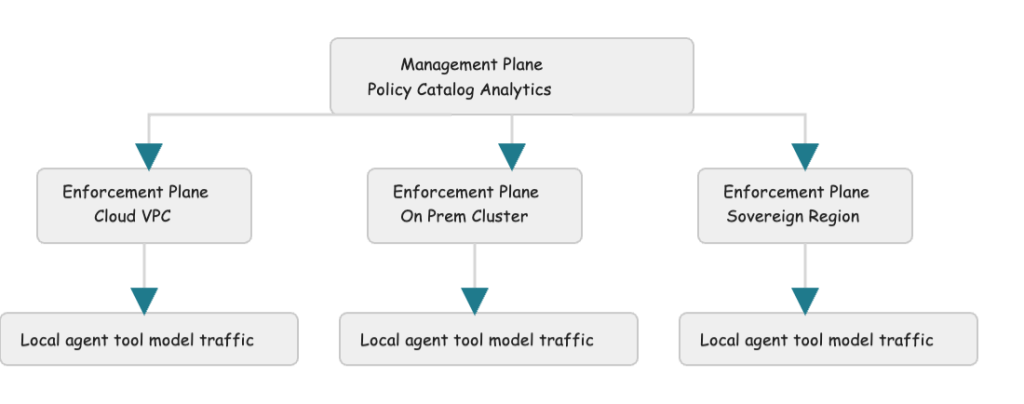
Regulated industries have a non-negotiable version of this requirement: the data a policy acts on cannot leave a controlled environment. An agent executing a health record lookup, a trading algorithm, or a classified document analysis must be governed by an enforcement layer running inside the same boundary as the data. This is not a preference. It is a compliance requirement in most regulated jurisdictions.
The architectural answer is a split-plane model. The management plane handles policy authoring, catalog management, analytics, and audit dashboards — it does not touch production data. Cloud hosting here is an advantage, not a compromise: automatic updates, no operational burden, no version drift between enforcement instances in Frankfurt and Singapore. The enforcement plane executes policy at the point of agent-to-tool traffic. It must run independent of the management plane — as a container in a customer-managed AWS VPC, as a Kubernetes sidecar in an on-premises cluster, as a VM-resident process in a restricted datacenter, or as a fully managed cloud service for organizations without such constraints.
Enforcement instances operating on the last distributed policy set is not a nice-to-have. For regulated deployments, it is the difference between a governance architecture that works and one that creates a new single point of failure in the infrastructure it is supposed to protect.
Gate test: if management plane outage halts deterministic policy enforcement, the platform fails this gate.
Design Gate IV: Extend Existing API and Data Governance, Do Not Duplicate It
The enterprise has ten to twenty years of API governance investment. An agent control plane that requires rebuilding authentication schemes, rate limiting rules, integration connectors, and data access policies from scratch is not a platform upgrade — it is a second governance tax on the same infrastructure.
Every enterprise with an existing API management platform has a catalog of governed endpoints: authentication policies, rate limits, SLA tiers, circuit breakers. Those same endpoints are exactly what agents need to call. The right question is not “how do I govern my agents” but “how do I extend and unify my governance to cover agents without rebuilding it.”
MCP Bridge is the concrete mechanism that answers that question. It converts any API instance already registered in an API catalog into an MCP-callable tool, governed by the policies already applied to that asset. An enterprise that has spent three years governing its Salesforce connector, SAP ERP integration, and Workday HR API can expose all three as agent-callable tools without rewriting a single governance rule and without modifying backend systems. The agents inherit the same constraints as every other calling application. No separate policy authoring step.
The depth of the connector library matters structurally here. A library of hundreds of pre-built connectors across SaaS, ERP, database, messaging, and legacy system categories — exposed through MCP Bridge — means the tools agents need in production (SAP, Oracle, Salesforce, ServiceNow, Workday, Snowflake, mainframe systems) are available through a governance-aware path from day one, rather than requiring custom integration development.
For organizations deploying agents without an existing API management foundation, a catalog of 100+ pre-built, production-ready MCP servers for commonly used SaaS platforms means starting with a governed tool library rather than governing tools retroactively. That distinction — governed from the first call, not governed after the first incident — is the practical difference between an agent governance program and an agent governance audit.
Gate test: if existing API policies cannot be inherited by agent-callable tools without rewrite, the platform fails this gate.
Design Gate V: Centralized Cost and Token Governance Across Model Providers
Model usage creates a cost surface that is invisible without deliberate instrumentation. A control plane that does not centralize token metering, cost attribution, and budget enforcement produces the same shadow spend problem that unmanaged cloud computing produced a decade ago.
The pattern is the same. Organizations running AI pilots discover model costs retroactively — after experiments have run for weeks without budget visibility, in quarterly financials rather than in real time. The solution to shadow cloud spend was not to restrict usage. It was to centralize metering so that every workload’s cost was visible in real time, attributable to a team or project, and subject to budget enforcement before the bill arrived. The same architecture applies to model usage.
A control plane positioned between agents and model endpoints captures every token request and response as it transits: model called, token count, latency, calling agent, timestamp. Aggregated across model providers routing through the enforcement layer, this creates a unified cost visibility dashboard. Budget thresholds trigger rate limiting or blocking before costs exceed authorized spend. Chargebacks to business units are based on actual metered usage, not estimates.
Two boundaries worth naming honestly: this governance covers model traffic routed through the enforcement layer. Agents that call model APIs directly through native SDKs, bypassing the gateway, produce telemetry in their own provider dashboards but not in the centralized view. The recommended architecture for any deployment where cost accountability matters is a policy requiring all model traffic to route through the enforcement layer. Discovery tooling that inventories agents and their declared model configurations across Agentforce, Bedrock AgentCore, Copilot Studio, and Vertex AI provides the inventory needed to identify what is outside the governed path and bring it in.
Gate test: if token and cost visibility remains provider-fragmented or post-facto, the platform fails this gate.
Design Gate VI: Runtime Portability Without Governance Rebuild
Committing to an agent control plane should not mean committing to a single cloud, a single region, or a single infrastructure vendor. When an agent workload migrates, governance policy should migrate with it.
Vendor lock-in in agent infrastructure has two distinct forms. The visible form is agent lock-in: agents built with a proprietary framework that cannot execute on a different runtime. The more insidious form is governance lock-in: policies, audit configurations, and identity integrations tightly coupled to a specific cloud provider’s governance infrastructure, so that migrating the agent workload means rebuilding governance from scratch. Organizations consistently underweight the second form because it is invisible at the time of the initial commitment.
This is where the hyperscaler governance tax compounds. A policy authored in AWS CloudFormation for a Bedrock agent has no equivalent in Azure’s policy model. The audit log format from CloudWatch does not map to Azure Monitor without custom transformation. Identity policies written for AWS IAM do not translate to Entra ID without a re-integration project. Years of governance investment stranded in a cloud provider’s proprietary constructs at exactly the moment a migration requires it.
A control plane built on open standards — HTTP enforcement, standard OAuth flows, catalog-registered assets with portable policy definitions — produces governance investment that belongs to the organization. When the agent workload moves, the governance moves with it. An agent endpoint governed on AWS can migrate to Azure or to on-premises infrastructure, and the policies that govern it migrate with the enforcement instance without reconstruction. For any agent that operates as an HTTP endpoint, governance attaches at the transport layer without changes to the agent code itself.
Gate test: if migration requires governance redesign rather than redeployment, the platform fails this gate.
Design Gate VII: Verified Identity Propagation Across Agent Chains
When an agent calls a tool, a model, or another agent, the receiving system deserves to know not just that the request is authenticated — but who authorized the action, on whose behalf it was taken, and what the chain of delegation looked like. Without that, every downstream system is making authorization decisions in the dark.
In a single-hop API call, authentication is straightforward: a service account presents credentials, the API validates them. In an agentic chain, an agent calls a tool that calls another agent that calls a model that accesses a data source. Each hop presents a credential. The data source at the end of that chain cannot see the human user who initiated the original task, the agent that decomposed it, or the authorization scope granted at the origination point. The consequence is concrete: an agent granted access to a CRM for “read customer records” that passes its credentials to a sub-agent that uses them to update records has exercised unauthorized scope. If the downstream system cannot distinguish the authorized principal from the delegated agent, it cannot enforce the original authorization boundary.
OAuth 2.0 Token Exchange — specifically the On-Behalf-Of (OBO) flow defined in RFC 8693 — solves the core problem. When an agent calls an MCP tool, the enforcement layer injects an access token scoped to the original end-user’s identity and permissions, not the agent’s service identity. The downstream MCP server sees a token it can validate against the original human authorization. The agent cannot exceed the authorization scope of the human it is acting for. This is implemented as a first-class enforcement policy, not as custom code in each agent.
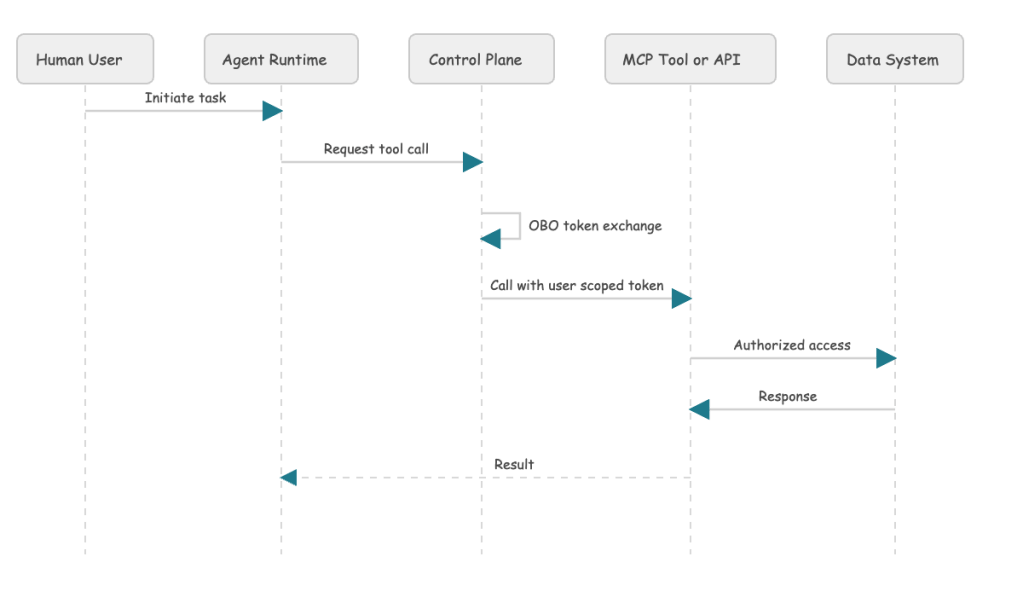
CIBA — Client-Initiated Backchannel Authentication — is the piece of this that often goes unnamed but matters significantly in production. In deployments where agents operate without interactive browser sessions — chat interfaces in Slack or Teams, autonomous pipeline agents, mobile applications — completing OAuth flows through browser redirect is not possible. CIBA allows the user to be prompted asynchronously through a secondary channel, approve the agent’s action, and have that authorization propagate without a synchronous redirect. This is specifically relevant for enterprise Slack bots, Teams integrations, and background pipeline agents that cannot interrupt a workflow with a browser pop-up.
For enterprises running Microsoft Entra ID, native support for the Entra OBO flow eliminates the need for a translation layer. Multi-IdP support — Entra ID for employees, Okta for partners, on-premises LDAP for compliance-critical systems — means agents operating across identity boundaries propagate context consistently without requiring IdP consolidation as a prerequisite for governance.
Gate test: if delegated human identity cannot be verified and enforced across hops, including headless flows, the platform fails this gate.
Operating Model: The Layer Architecture Cannot Replace
A control plane without operating ownership is governance theater.
The architecture described in the gates above is necessary but not sufficient. Enterprises that have deployed API governance programs know the pattern: the platform is solid, the policies are defined, and six months later the exception queue is 200 items deep because no one owns exception approval. The same failure mode applies here, and it moves faster because agent capabilities and model access patterns change week to week.
A production-ready operating model defines:
Ownership
- Who authors, reviews, and promotes policy changes (not a committee — a named owner with a backup)
- Who holds exception approval authority, at what scope, and for what duration
- Who owns incident response for bypass events, identity misuse, and data egress
Cadence
- Weekly: exception queue review — open exceptions, compensating controls in place, time-to-close
- Monthly: control assurance checkpoint — does declared policy equal enforced policy? Spot-check three gates
- Quarterly: gate recertification — as new runtimes and model paths are added, do gates I–VII still hold?
SLAs
- Exception decisions: defined window (e.g., 48 hours for standard, 4 hours for high-risk)
- Bypass remediation: deadline from detection to remediation
- Critical policy rollback: objective from incident declaration to enforcement restoration
Break-glass
- Defined boundaries for when enforcement can be bypassed (incident response, system failure)
- Audit requirements for every break-glass event
- Automatic expiry on any bypass — no permanent exceptions
Tests Worth Running Before You Commit to a Vendor
The failure modes this framework addresses: governance sprawl, perimeter fragility, and the hyperscaler governance tax, share a root cause: governance designed around who owns the runtime rather than what the asset is. An asset-aware control plane inverts that design. Every new agent runtime added, every new model endpoint registered, every new SaaS tool connected inherits governance already in place rather than requiring it to be rebuilt. The governance investment compounds.
The practical test for any control plane is the migration test. If your organization needed to move a production agent workload from one cloud to another next quarter, how much governance reconstruction would that require? If the answer is “most of it,” you are renting governance. If the answer is “redeploy the enforcement component, no policy reconstruction required,” the architecture is portable.
The second test is the extension test. If your organization has existing API governance covering SAP, Salesforce, and Workday, can those policies extend to agent-callable tools without a rewrite? If so, the control plane is leveraged. If not, it is a second tax on infrastructure the enterprise already paid to govern.
A control plane that converts existing API governance investments into agent-callable tools, enforces identical policy at the HTTP transport layer regardless of agent origin, deploys its enforcement component wherever compliance requires, propagates human identity through multi-hop agent chains with CIBA support for headless flows, and meters every model call routed through the enforcement layer – that control plane is not hypothetical.


