In FX’s The Bear, the restaurant lives by three words: “Every second counts.” A world-class kitchen cannot deliver split-second service during the dinner rush if the prep team hasn’t organized, prepared, and standardized the ingredients hours beforehand. For healthcare IT teams, that high stakes environment feels all too familiar, where split second delays in accessing patient data directly impact care delivery and clinical outcomes.
The healthcare data dilemma: Volume vs. velocity
Every day, healthcare organizations experience a data dilemma: Millions of patient records scattered across legacy electronic health records (EHRs), lab systems, billing tools, and many other systems. And oftentimes, each individual system contains duplicate patient profiles, or outdated data. This, coupled with care teams and patient portals needing instant, to the second, context: How do you provide accurate, up to date, information to people and systems when your data lives in silos?
When you try to solve both volume and velocity problems in the same application layer, your enterprise integration suffers. Forcing your real-time API layer to wear too many hats, data cleaning, de-duplicating, and identity resolution on the fly, causes timeouts, delays at the point of patient care, and overall server latency.
On the other hand, relying on daily batch integration prevents care teams from having up-to-date information when it matters most. To deliver instant and accurate care, your integration architecture must separate the back of the house data hygiene from the front of the house API delivery.
How Informatica and MuleSoft power real-time interoperability
To solve volume and velocity problems, you need two separate power houses to each take on an important role: Informatica as a data hygiene tool to ensure accurate, up-to-date data, and MuleSoft to deliver clean information in real time.
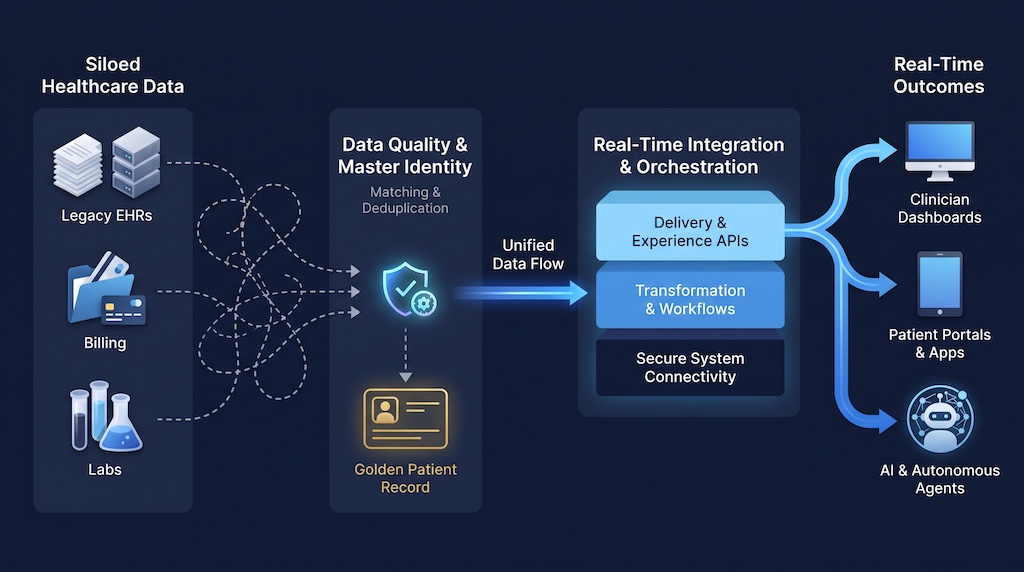
Informatica: Standardizing the master record
In healthcare, a single patient might be entered as ‘John Smith’ in the billing system, ‘J. Smith’ in the lab system, and ‘Johnny Smith’ in the EHR. Imagine if you had the ability to sync these records and create a ‘Golden Patient Record’?
Enter: Informatica.
Informatica works continuously behind the scenes. Matching names, birthdays and addresses while throwing out duplicate records, fixing typos, and merging everything into a single source of truth profile. This means data is 100% accurate before anyone, or any system, asks for it.
MuleSoft: Delivering high-speed, reusable APIs
Now that your data is clean, MuleSoft delivers that prepped data in real-time. Using a three-layer architecture approach, APIs are built once and reused across an organization:
- Starting with the System Layer, this layer is responsible for securely unlocking underlying EHR systems, master databases, and sources of record.
- Next comes the Process Layer where master patient data and business logic are combined – like checking if a doctor is free at 2:00PM or if an operating room is open.
- Finally, the Experience Layer, where payloads are formatted and delivered directly to the experience – like a clinician dashboard on a doctor’s iPad or a patient portal iPhone app. APIs Delivering clean data is not only critical for care teams and patients but it also provides a foundation for AI tools and autonomous agents.
Extending interoperability to Agent Fabric and AI orchestration
AI agents are only as smart as the data they have access to. If you provide duplicate or outdated patient files, how will AI agents know how to use that data? Think of agents sending conflicting appointment reminders to patients or incorrect care plans or maybe even worse: sending sensitive lab results to the wrong patient. To avoid this, agents need fresh, clean context to work safely.
MuleSoft and Informatica help power Agent Fabric in three ways:
- Grounded Context: MuleSoft delivers clean, real-time data from Informatica’s master record directly to AI agents.
- Governed Action: When an AI agent needs to perform a specific action, it triggers MuleSoft Process APIs to execute that workflow behind the scenes.
- Security: MuleSoft’s API gateway enforces strict HIPAA policies and access so that AI agents can only read and write data that they are explicitly permitted to touch.
Better together, having this unified architecture can help organizations achieve both quantitative and qualitative outcomes.
Improving patient outcomes through unified architecture

When you bridge backend data hygiene with real-time API orchestration, the business and clinical benefits ripple across your entire health system:
- Eliminated Redundancies: Clinicians no longer waste time reconciling duplicate charts or ordering redundant diagnostic tests.
- Instant Point-of-Care Access: Care teams immediate, up-to-second patient context on their mobile devices or workstation dashboards the moment a record updates.
- Scalable AI Adoption: Your organization can confidently deploy autonomous agents through Agent Fabric, knowing they operate on secure, real-time data.
- Future-Proof Interoperability: Standardized API layers allow you to adopt new clinical applications or digital tools without rebuilding backend data pipelines from scratch.
Ultimately, all of this leads to better care outcomes, and increased patient satisfaction, while lowering the stress of the clinicians who serve them.
Build your real-time healthcare foundation
Healthcare IT leaders don’t have to choose between data hygiene and real-time speed, they can have both. By leveraging Informatica to establish a clean master data foundation and MuleSoft to orchestrate real-time APIs and AI agents, your health system can eliminate operational friction and ensure data is accessible when and where it is needed most.
To learn more about building a composable health strategy, explore MuleSoft’s Healthcare Integration Solutions and discover how Anypoint Platform powers real-time interoperability across Salesforce Agent Fabric.
When your backend data is prepped and your API integrations are running at full speed, your health system operates like a Michelin-star kitchen firing on all cylinders. Just like on the line in The Bear, delivering exceptional patient care means eliminating every second of friction—because in healthcare, every second truly counts.