The speed at which your facility moves a patient from a referral to a care plan is a primary differentiator in today’s competitive healthcare landscape. The key to making this happen? Digitizing your “front door,” to eliminate the silent bottleneck of manual data transcription that currently traps your clinical reports in static and potentially insecure, PDF formats.
Your strategy focuses on transforming these unstructured documents into high-fidelity, decision-ready data using the combined power of MuleSoft IDP and Agentforce for Healthcare. Through automated workflows, you ensure your clinicians spend their time on diagnoses and treatment plans rather than hunting for data points and history scattered across multiple documents. Ultimately, your shift to intelligent extraction accelerates clinical intake, allowing your organization to deliver life-changing decisions with unprecedented agility.
The Strategic Crisis: “Information Readiness” Gap
When your receiving facility receives a referral, the primary obstacle to a timely decision is not clinical expertise, but information readiness. Currently, your incoming patient medical reports and history arrive as a mountain of unstructured documents, often spanning dozens of pages of non-searchable text, across many different, disconnected systems, leaving your staff to manually hunt for critical data points and transcribe them into a system of record before your clinicians can even begin their review. This “Information Readiness Gap” forces your highly trained clinicians to wait on tedious administrative cycles before they can decide whether to accept a patient, creating a lag that can adversely impact patient outcomes .
Not only can your patients potentially suffer from this wait time, but by failing to address this gap, you risk referral leakage and prolonged wait times that frustrate both providers and patients.
Architecture of Intelligence: A Tiered Integration Approach with Salesforce and MuleSoft
Overcoming your intake bottleneck requires a synergistic ecosystem where data flows seamlessly from a document to a clinical record without manual interference. By combining Salesforce Agentforce for Healthcare with MuleSoft IDP, you create a “tiered” architecture that manages this complex transition with enterprise-grade reliability. Salesforce Agentforce for Healthcare serves as your System of Action — the centralized workspace where your clinical reviews and acceptance decisions occur. Your MuleSoft System API (SAPI) handles the secure, specialized connectivity to your Salesforce Agentforce for Healthcare instance, while your Process API (PAPI) orchestrates the sophisticated logic required to move files through the extraction pipeline.
This modularity is your greatest asset; unlike rigid, monolithic legacy systems, this tiered approach ensures that your integration isn’t just a fragile point-to-point connection — it’s a governed, scalable fabric. It empowers your IT teams to update extraction models or modify clinical workflows independently as medical regulations change, ensuring your platform remains agile and responsive. By decoupling the extraction logic from the user interface, you provide your organization with a durable framework that can scale across multiple departments, absorbing increasing referral volumes without requiring a proportional increase in technical debt or administrative headcount.
Deep-Dive: From Unstructured to Actionable Data
The technical core of your solution lies in the Extraction Loop, a sophisticated process designed to handle the variability of medical documentation. When your medical reports are received, your MuleSoft PAPI retrieves the attachments (via MuleSoft SAPI for Salesforce Agentforce for Healthcare) and submits them to MuleSoft IDP. By leveraging the extraction and reasoning capabilities of Large Language Models (LLMs), your system identifies and extracts key clinical data fields from unstructured text with a level of nuance that traditional tools simply cannot match. It recognizes the context of the data, ensuring that names, dates, and medical histories are mapped correctly.
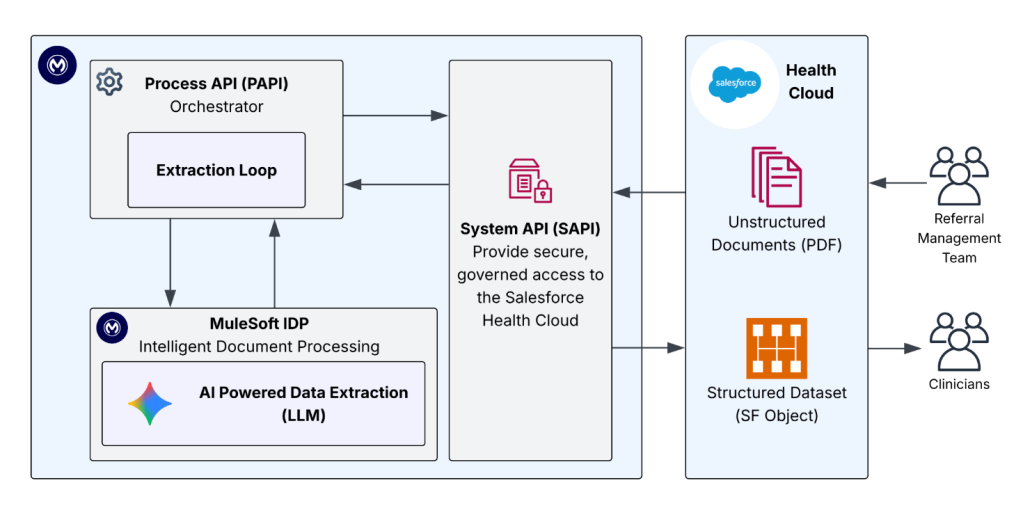
Tactically, your solution loops through every document in a referral packet, receives a structured response for each, and evaluates the “Value Score” to verify accuracy. This confidence-based logic acts as your quality control; if the extraction meets your pre-defined threshold, the data is consolidated and pushed via SAPI into your Agentforce for Healthcare instance. The result is a pre-populated data set that is presented to your clinician. You are essentially transforming a chaotic pile of PDFs into a structured, digital executive summary, providing your clinicians with a clear, concise view of the patient’s history for immediate and informed review.
Metrics of Success: KPIs for Healthcare
To measure the true impact of your digital transformation, your organization now has the ability to track the Clinician Decision Lead-Time. This metric represents the total time elapsed from the moment your facility receives a referral package to the moment your clinician renders an “Accept/Decline” decision. In a manual world, this duration is often measured in days; by automating your “data prep” phase, your facility can drastically shorten the time your clinician spends waiting for a record to be digitized, often bringing the window down to hours or minutes. This acceleration directly correlates to improved patient care outcomes and higher satisfaction among referring providers.
Beyond speed, MuleSoft IDP teamed with Agentforce for Healthcare monitoring your Extraction Accuracy Rates — measuring how often your LLM-extracted data perfectly matches your source documents to ensure clinical safety and trust in the system. Additionally, evaluating your Administrative Reallocation can track the significant reduction in manual data entry hours, providing a clear view of the labor costs saved. By freeing your staff from the “keyboard trap,” you allow them to focus on higher-value patient coordination and complex case management, ensuring that your human capital is invested in care delivery rather than manual data extraction.
Conclusion: Your Blueprint for Efficient Intake
Your move toward digital document extraction is a fundamental shift in how your facility manages its “front door.” By embracing a tiered integration strategy that leverages the best of MuleSoft and Salesforce, your organization bridges the gap between messy, unstructured medical reports and decisive clinical review. This transformation is about more than just technology; it is about reclaiming time for your providers. This approach does not replace the expert judgment of your clinician; rather, it empowers them by removing the “noise” of manual data entry that so often leads to burnout and oversight.
Your roadmap to referral excellence focuses on creating an integrated, intelligent intake engine that delivers the precise information required at the exact moment it is needed. As you move forward, this digital foundation will allow your facility to scale effortlessly, handling higher volumes with greater precision. Ultimately, by digitizing the intake process, you are clearing the path for your clinicians to do what they do best: making informed, life-changing decisions for your patients without being slowed down by the limitations of paper-based workflows.