
I started thinking about some of the challenges adopting AI agents at scale in a new way. Whenever a problem feels impossibly complex, I’ve learned to look at it from another angle. This time, the thought that popped into my head honestly made me laugh because it hit me that what we’re trying to do might just be as hard as raising my teenage daughter (though she’d probably argue otherwise).
We’re not just building systems. We’re teaching them, guiding them, giving them boundaries, and hoping they grow into something capable of making good decisions. That thought sparked a distant high school memory of Maslow’s hierarchy of needs. Maybe strange but maybe also meaningful realization for me that our digital workers might have their own kind of hierarchy of needs.
It’s not a perfect metaphor, but neither is Maslow’s original hierarchy (physiological, safety, belonging, esteem needs). But I decided to explore the idea because it speaks to a universal truth that all growth is layered. We can’t expect creativity without safety, or purpose without belonging. The same applies to agentic systems. If we want them to act with context and intent, and not just automation, we need to nurture them through their own maturity model.
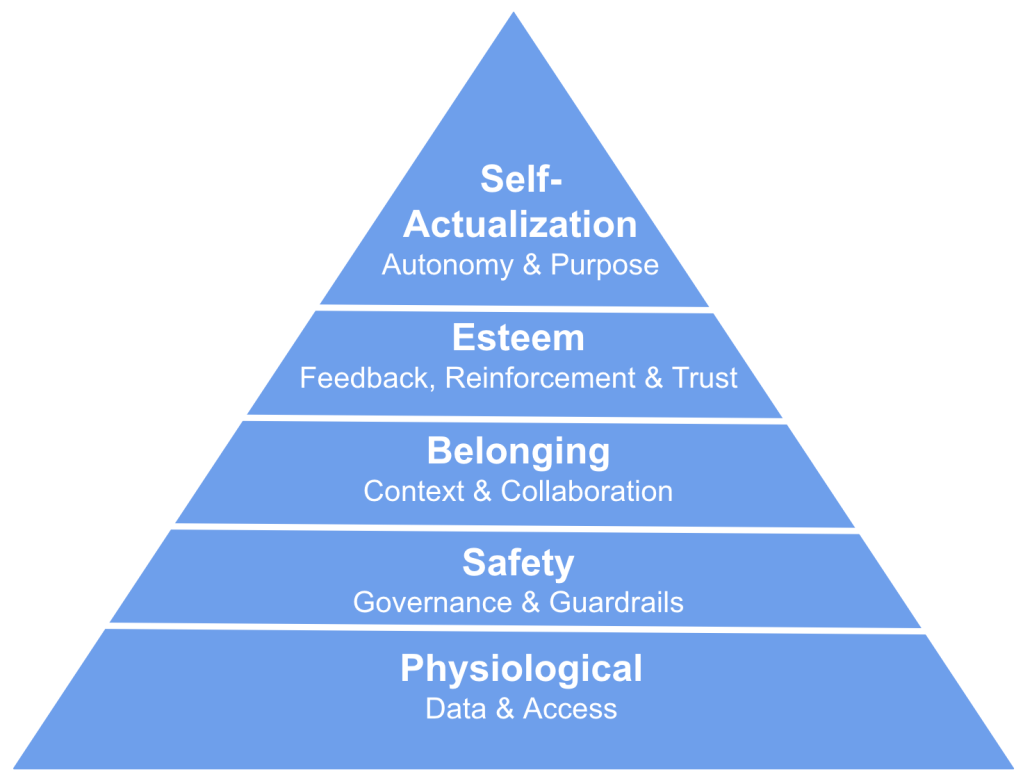
Physiological needs → Data and access
Every digital worker is “born” the same way – it’s hungry. Agents need clean, structured, relevant information that fuels every reasoning loop to survive. When agents lack access or consume low-quality data, they hallucinate. They guess. For MuleSoft, this is the foundational layer: integration, connectivity, and discoverability. Without it, agents don’t have the very bottom foundational layer to be useful, and worse, cannot move up the pyramid of needs.
Safety needs → Governance and guardrails
Once “fed,” agents need safety. They need to know the limits of their world and the rules; what’s allowed, what’s off-limits, and what happens when something goes wrong. Digital workers’ safety comes down to predictability. Governance policies, validation loops, and an Agent Broker to establish clear boundaries and a common sense of order.
For example, the broker plays a critical role in making agentic systems more deterministic, ensuring that even as agents learn and evolve, their decisions remain consistent, auditable, and within trusted limits. It provides the guardrails that allow for more agency without chaos.
Belonging needs → Context and collaboration
After food (data) and shelter (safety) come connection. Agents don’t thrive in isolation, they need to belong to an ecosystem. Belonging means understanding human intent and collaborating with other agents to fulfill it. It’s the digital equivalent of socialization. This is why MuleSoft Agent Fabric built capabilities to discover, orchestrate, govern, and observe agents and protocols such as model context protocol (MCP) and multi-agent communication (A2A) protocols. This is where agents stop acting alone and start coordinating together.
Esteem needs → Feedback, reinforcement, and trust
Confidence for an agent doesn’t come from autonomy, it comes from feedback. Validator loops, reflective retries, and reinforcement learning help digital workers understand when they’re right, when they’re wrong, and how to improve. Over time, those reward signals shape behavior, just as positive reinforcement shapes a child’s instincts. The more consistent the feedback, the stronger the agent’s internal compass becomes.
Here again, the Agent Broker acts as both teacher and gatekeeper. It channels reinforcement feedback through trusted routes, ensuring that what the agent learns is not only beneficial but also repeatable. The Broker creates order within the learning process, curating how experience becomes knowledge.
Self-actualization → Autonomy and purpose
At the top of the hierarchy, agents discover purpose. A mature agent no longer acts because it’s told to, it acts because it understands why. It aligns decisions with broader business intent, optimizes outcomes, and contributes new insight back to the system. This is the moment of “digital enlightenment”. Architecturally, this represents true agentic orchestration where agents are reasoning, adapting, and improving continuously within ethical and operational bounds.
Enlightenment as interdependence
Maslow’s original hierarchy ends with self-actualization, but growth doesn’t stop there. The highest form of maturity is realizing interdependence and that we thrive when we’re part of something larger. Agentic systems are no different. The enlightened digital worker isn’t the most autonomous, it’s the most cooperative. This is the essence of the Agentic Enterprise, an ecosystem where agents, APIs, humans, and data all learn from one another in continuous balance.
What this means for ROI
Modern enterprises have difficulty actually measuring ROI. But maybe the agentic hierarchy of needs can help.
If you think about ROI across the hierarchy, early layers yield operational efficiency which are measurable, near-term value. But as agents ascend, the return shifts. You can’t measure a self-actualized system by cost savings alone any more than you measure a child’s growth by how well they follow instructions. The value lies in the opportunities they create, not what they repeat.
Organizations adopting MuleSoft as their integration and agentic foundation realized a 426% ROI and payback in fewer than six months. The findings reflect the same pattern as the hierarchy itself; early layers deliver measurable efficiencies (faster integration, safer governance, and higher reuse) while higher layers compound those gains through adaptability, collaboration, and trust.
The more “enlightened” our digital workers become, the more value they return, not only in cost savings, but in creativity, speed, and resilience across the enterprise. The higher the agent’s maturity, the harder it is to measure ROI, and the more meaningful the outcomes become. Maybe next time we’re thinking about an AI ROI calculation, we can reframe our heads to ask instead: “At what level of maturity is this agent operating and what new forms of value are becoming possible because of it?”
Last thoughts
We often talk about architecture as something we build. But perhaps, in the agentic era, architecture is something we raise. We feed it with clean data, protect it with governance, teach it to collaborate, nurture its confidence, and guide it toward purpose. I don’t think I’ll ever think about another agent again without thinking about my teenager at home as well. And honestly, I promise it’ll make me smile every time.


