
A field guide to the identity, cost, access, and audit questions that decide whether your agents reach production.
Your AI agent demo works. Now your security team, your finance team, and your chief information officer (CIO) have questions:
- Who is allowed to call what?
- Whose identity does the agent use?
- Who pays for it?
- What happens when a control fails?
These questions, not the model, often decide whether an agent project ships. This post gives you six areas to govern before your agents scale. It also gives you a go-live checklist you can use this quarter.
The demo is the easy part
Picture an agent that looks up customer and policy details and helps a colleague prepare for a meeting. It chains several tool calls and returns clear answers. It looks ready.
Then three questions arrive:
- Which systems does it call, and who owns them?
- Whose permissions does it run with?
- If something goes wrong, who can see what it did, and who can stop it?
You can’t answer these from the demo. The model is one component. The environment around it decides whether your project ships.
The same gap keeps showing up
Teams often hit the same wall. They need model access, and the approved route isn’t ready. So someone sets up a temporary exception and calls a provider directly. With a deadline coming, that’s a reasonable choice. Then the exception stays.
That one path now sits outside your cost reporting and your logs. It tends to surface months later, when security asks for an audit trail and nobody can produce one.
Two related problems follow. First, credentials end up in code because there was no better place for them. GitGuardian’s State of Secrets Sprawl 2026 report found 28.65 million new hardcoded secrets in public GitHub commits in 2025, a 34% jump over the year before.
Second, AI spend lands in one shared pool that you can’t break down by team, user, or agent.
Your teams aren’t being careless. They’re moving fast while shared controls lag behind. The fix is to make the governed path the easiest path.
Why reuse beats rebuild
You’ve solved a version of this problem before with API governance. The lesson is to reuse what works: the same identity provider, the same policies where they fit, and one place where traffic flows.
A separate set of controls built only for agents would recreate the sprawl you spent years cleaning up. Don’t build a parallel world for agents. Extend the one you already trust.
Agents do add one new requirement. An agent decides its own next step, while a normal API client does what its code says. That means you need to see exactly what an agent did. You also need to be able to stop it quickly.
The six things to govern
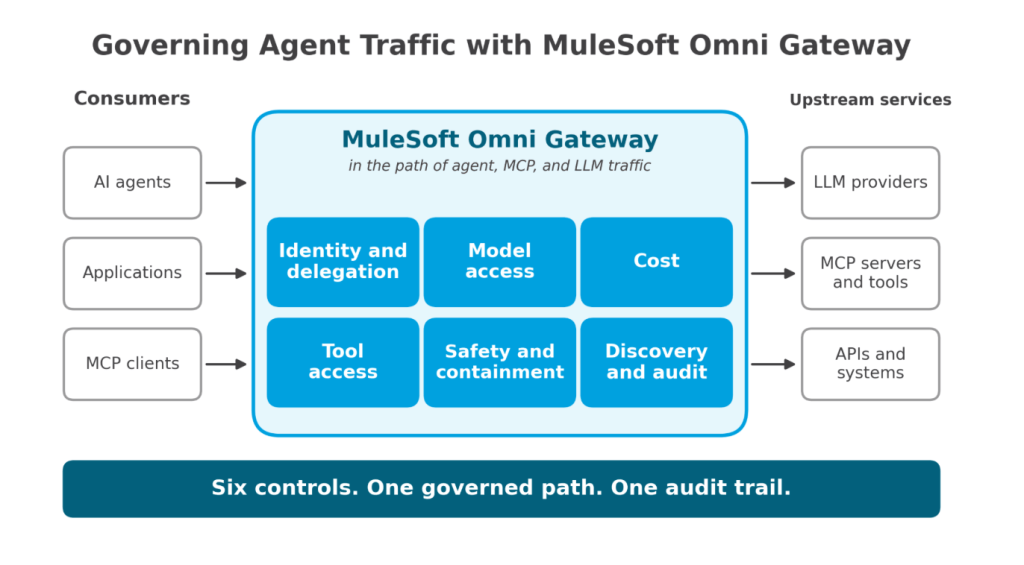
Diagram of MuleSoft Omni Gateway applying six controls to agent traffic: identity, models, cost, tools, safety, and audit
1. Agent identity and delegation
Use the identity provider you already have. When an agent acts for a person, it should carry that person’s rights.
A shared service credential makes it hard to say who did what afterward. It can also give the agent far more access than any single person would have.
Quick check: Pick an action an agent took last week. Can you name the person it acted for? If not, you have a gap.
2. Model access
Give your teams one controlled path to every model through an AI gateway. With a single governed endpoint, a new model or provider doesn’t need new credentials or a new set of logs.
Set up fallback routing to a second model or provider, and test it before you need it.If some traffic can bypass the path, your policy is only a suggestion.
A ready governed route also removes friction. When it’s available before the deadline, nobody needs a temporary exception.
3. AI cost control
Track spend by team, user, and agent. Set limits that stop a runaway loop before the invoice arrives.
Agents can loop. A bug or a bad prompt can turn a small task into many more calls than you expected. Limits protect your budget and your systems.
Add cost controls early. They’re harder to add after launch, and finance will ask.
4. Tool access
Agents are only as useful as the systems they can reach. Expose the APIs you already have as governed tools. Keep their authentication and entitlements, and don’t rebuild them for agents.
Before you scale, check that the APIs your agents need can be reused. Each one should be documented, owned, and not dependent on one person who knows how it works. Teams whose APIs are documented and owned have less groundwork to do before agents can use them. The numbers show the opportunity. MuleSoft’s 2026 Connectivity Benchmark Report found that, on average, 50% of internal software assets are available for reuse.
5. Safety and containment
Sensitive data can leave in a prompt or return in a response. Put guardrails in both directions.
Make sure someone can stop a single request, a session, or a whole agent. Decide in advance who has the authority to make that call.
Then decide what happens when a control itself fails. Say you route every request through an external authorization check. What should the agent do if that check is down? Block everything, or let requests through?
There’s no universal answer. A payments system may fail closed, which means it blocks requests. An internal assistant may fail open for a short time, which means it allows them. What matters is that someone makes that choice on purpose, before production and not during an outage.
6. Discovery and audit trail
Agents will appear on platforms you didn’t plan for. You need a way to see what is running across your company.
Your logs must also be good enough to reconstruct an incident. A strong audit trail answers four questions:
- Which agent acted?
- For whom?
- On which systems?
- With what result?
If your logs answer all four, security reviews get much easier.
Answering the cost objection
Adding a governed layer sounds like one more thing to pay for and run. That concern is fair.
Now compare the alternatives. Without a shared layer, every team may build its own routing, key handling, logging, and cost tracking. The total cost can be higher. It’s spread across teams, so nobody sees the full bill.
Build a go-live checklist
A simple go-live checklist is one of your most useful tools. It defines what “ready” means. It also brings security in early, so their constraints shape the design. That builds more confidence than another architecture diagram.
Start with this version:
- Every model call goes through the approved path
- Every agent action maps to a named user or a named owner
- Spend limits are set per team and per agent
- A named person can stop an agent, and they know it
- Your team has decided how controls behave when they fail
- Logs can answer the four audit questions above
Also make sure you can add your own rules where traffic passes through, such as inspecting, redacting, or rate-limiting. Built-in policies cover most needs. There’s usually at least one requirement they don’t, and you want to find it before launch.
Where AI agent governance is heading
Governance will have to follow the chain, not just the request. When agents call other agents, every hop must carry the original user’s identity and rights. Your audit trail must connect the whole delegation path. Without that, you see each step but not the story. Open standards such as the Agent2Agent (A2A) protocol already describe how agents delegate tasks to each other.
Observability must also move past “is it running?” to “what did the agent do, and was it right?” Teams that log well now will be ahead when that question matters.
Where to start
Start with the basics. If you only have time for three checklist items this quarter, choose these:
- Put every model call on one governed path
- Tie every agent action to a person or an owner
- Decide, on purpose, how your controls behave when they fail
Then pick one agent already running in your company. Try to answer the four audit questions about it. The gaps you find show you where to go next.
See how these controls work in practice in MuleSoft Omni Gateway governance and try out Agent Fabric for yourself.


