
AI agents are changing a basic assumption behind digital experience design: the user may no longer be the one opening your application.
A person can ask an agent to research a purchase, update a customer record, book travel, or complete a workflow. The agent may go straight to an API, a Model Context Protocol (MCP) tool, or another machine-readable capability. That is exactly why headless architecture, which separates business capabilities from the interface (the “head”) that presents them, fits the agentic era so well.
But there is a catch. When an agent bypasses the user interface, it may also bypass business value that quietly lived there. Recommendations, explanations, disclosures, loyalty benefits, product education, and upsell opportunities can all disappear if you treat the interface as disposable instead of decoupled.
Headless should mean that you can support many heads. It should not mean that you no longer need an experience strategy.
Why headless architecture fits the agentic era
Headless architecture fits the agentic era because it separates business capabilities from a single presentation layer. A person may use a web or mobile interface, while an AI agent can discover and invoke the same capability through an API, MCP tool, or another machine-readable interface.
That flexibility can reduce dependence on user interface automation and allow the same governed capability to support many experiences. A customer might use a website, an employee might work through an AI agent, and a partner application might call the same underlying service.
But this flexibility introduces a new design question: What happens to the business context that used to live in the interface?
A user interface often does much more than submit a transaction. It helps people discover options, understand choices, see recommendations, review policies, and decide what to do next.
When an agent takes a different path to the same business capability, some of that context may no longer be part of the journey.
And that is where headless architecture becomes especially interesting in the agentic era.
What gets lost when agents bypass the UI
Consider online shopping. A human visits a product page and encounters a carefully designed experience. There are recommended products, sponsored placements, reviews, bundles, loyalty offers, comparison tables, warranty information, and the occasional suggestion that the $129 version is somehow worth $30 more than the $99 version.
An agent has no thumb to keep scrolling.
Meta’s Muse makes the change tangible. Meta describes Muse as a personal agent that can open a browser, fill out forms, negotiate on a person’s behalf, and ask for approval before a purchase. A shopper can increasingly delegate the work between intent and transaction to software.
If the shopper asks, “Find me the best cordless drill under $150 with strong reviews and delivery by Friday,” the agent may compare structured facts and return one recommendation. The transaction can succeed even if the shopper never sees a carousel, a banner, or a “customers also bought” module.
From the shopper’s perspective, that can be wonderfully efficient. From the retailer’s perspective, the purchase path just changed shape.
This does not mean recommendations or advertising disappear. Amazon is already adapting them for its own agentic shopping experience. Alexa for Shopping can answer product questions, generate comparisons, automate deal finding, and surface sponsored products inside conversational interactions. Amazon is also developing branded conversations that bring product guides, compatibility information, and brand-supplied content into the agent experience.
The lesson is not that agents remove influence. The lesson is that influence moves from pixels to context.
The value-plane gap in agentic experiences
This creates an architectural gap that is easy to miss.
Traditional API design asks whether a consumer can retrieve data, execute an action, authenticate securely, and stay within policy. Those questions still matter. Agentic systems add another one: does the agent receive the business context that used to live in the experience?
Imagine that a commerce platform exposes four perfect capabilities: search products, get product details, add to cart, and checkout. An agent can now buy something. But where are the recommendations, bundles, loyalty benefits, disclosures, compatible accessories, or explanations that help a customer choose well?
If those functions exist only as UI components, the agent can bypass them without doing anything wrong. The API works. The transaction works. The architecture may even pass every reliability test. Yet part of the business model is missing.
Call this the value-plane gap: the space between “the agent can complete the task” and “the interaction still delivers the customer and business value the experience was designed to create.”
How MuleSoft and AIforce can help close the gap
AIforce brings Salesforce capabilities to AI interfaces through MCP, APIs, plug-ins, and skills. Those interactions continue to use Salesforce permissions and business rules, so an agent can get a new interface without requiring the enterprise to rebuild the logic behind it.
Now imagine a retailer already has a recommendation API. MuleSoft MCP Bridge can expose only the relevant API operation as an MCP tool, without changing the underlying service. That tool could return recommendations together with structured context, such as eligibility, an explanation, or a required disclosure.
Agent Fabric can then put governance around that interaction. Omni Gateway can enforce policies on the MCP traffic, while Agent Visualizer provides visibility into the agents, MCP servers, tools, calls, and errors involved. An Agentforce agent or another MCP-aware client can consume the capability without losing the controls around it.
Recent Agent Fabric updates make this pattern even more concrete. MCP Bridge can expose output schemas for existing API operations, making those capabilities easier for Agentforce and other MCP-aware clients to consume. Universal policies let teams define governance centrally and apply the appropriate controls across supported gateways. Agent Visualizer adds visibility into relationships between agents, MCP servers, tools, calls, and errors, helping teams understand how agentic interactions behave in production.
This is the difference between making a transaction headless and making the business capability agent-ready. The agent can bypass the page without bypassing the context and controls that matter.
Make experience logic reusable and agent-ready
The fix is not to force agents to behave like humans. Making an AI agent click through six screens just to preserve page views would be a strange victory for digital transformation.
Instead, identify the experience logic that deserves to become a reusable capability.
A recommendation should not exist only as a carousel. It can become a capability that returns relevant alternatives or complementary products based on customer context, intent, inventory, and policy.
A promotion should not exist only as a banner. It can become structured information with eligibility, value, expiration, and conditions.
A disclosure should not depend on whether someone happened to render the right page. It can become a governed requirement associated with an action.
The same principle applies to enterprise software. If employees increasingly ask Agentforce or another enterprise agent to update records, summarize accounts, initiate workflows, or resolve service issues, they may spend less time inside conventional application screens. Feature education, approval context, warnings, and guidance should not vanish simply because the user chose a different head.
This is where AIforce and MuleSoft become especially relevant. Salesforce is turning application functions into reusable enterprise capabilities, while MuleSoft provides the integration and governance needed to expose capabilities across heterogeneous systems. Together, that points toward an architecture where experience logic can travel with the capability instead of remaining trapped in a page.
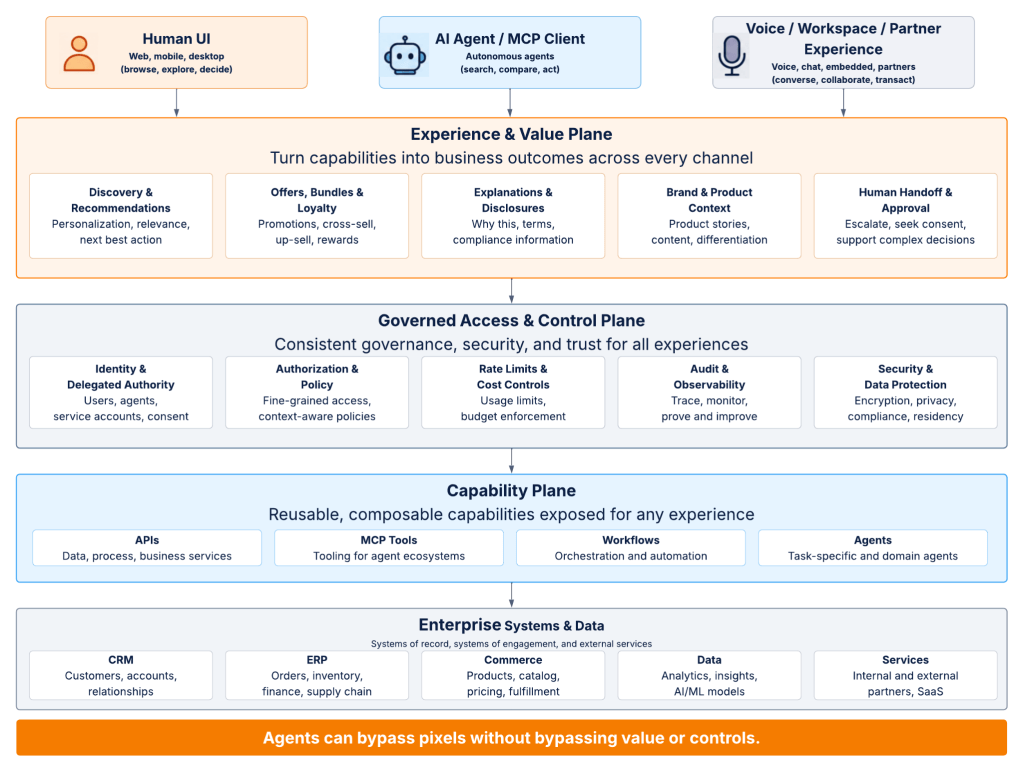
Figure 1. A multi-headed architecture lets agents bypass pixels without bypassing value, context, or controls.
The capability plane answers: Can the agent do this? APIs, MCP tools, workflows, and agents expose the actions.
The control plane answers: Should the agent do this? Identity, delegated authority, security, policy, cost controls, and observability govern execution. Agent Fabric is designed for this cross-ecosystem governance problem.
The value plane answers: What context should accompany this action so the interaction remains useful to the customer and the business? That includes recommendations, alternatives, explanations, offers, disclosures, brand context, and human approval points.
You need all three. Capability without control is risky. Control without capability is not very useful. Capability and control without value can produce a beautifully governed transaction that quietly erodes the experience around it.
Questions to ask before you make an experience headless
As you make more systems agent-ready, add a few questions to the architecture review.
1. What business value currently exists only in the UI?
Inventory recommendations, education, promotions, warnings, approvals, loyalty, cross-sell, and other behaviors embedded in the experience.
2. Which of those behaviors should survive?
Not everything should. Agentic systems give you a chance to remove unnecessary friction and dark patterns rather than translate them into machine-readable form.
3. How will an agent discover relevant context?
If an offer, policy, comparison, or explanation matters, expose it as structured context or a discoverable capability.
4. Can you identify both the agent and the person or system it represents?
Delegated authority becomes critical when an agent moves from recommending an action to executing it.
5. How will you measure value without relying on page views and clicks?
Agentic experiences may shift measurement toward recommendations considered, offers accepted, actions completed, human interventions, and outcome quality.
6. Where should a human stay in the loop?
Headless does not mean humanless. Some decisions still benefit from judgment, consent, emotion, or simply seeing the options before committing.
Headless, not head-free
Headless architecture suits agents because it separates business capabilities from a single interface. It gives you the flexibility to serve people, agents, voice experiences, partner systems, and whatever new head arrives next.
The risk appears when you confuse “the agent does not need the screen” with “the screen contains nothing important.”
Your old interface may have carried discovery, trust, education, monetization, and policy alongside the transaction. As agents create new paths through your systems, you need to decide which of those functions remain valuable and make them available in forms an agent can understand.
That is the next step for headless architecture. Do not preserve the pixels. Preserve the value behind them. Learn more on how Agent Fabric can enable headless architectures.


