
Navigating the complex digital landscape of today means you often face fragmented monitoring when integrating multiple systems. Historically, disparate observability solutions existed across services, leaving you with telemetry data that lacks a standardized schema or centralized visualization mechanism.
Standardizing the telemetry pipeline
To solve this challenge, i360 Integration Intelligence bridges robust API development directly into the Salesforce ecosystem. This powerful capability ushers in a new era of observability, standardizing data pipelines, schemas, and storage for your customer-facing telemetry data.
- Embracing OpenTelemetry (OTel): Whether your applications are deployed on CloudHub, CloudHub 2.0 or Runtime Fabric (RTF), i360 Integration Intelligence captures critical signals using vendor-neutral OpenTelemetry (OTel) standards. OTel provides a unified framework that decouples telemetry generation from its backend consumption, allowing your developers to instrument services once. By adopting these consistent APIs and semantic conventions, you ensure portability and interoperability across your distributed systems
Ingestion and streaming architecture
Once your telemetry data is generated, the MuleSoft Ingestion Platform collects it and enriches it with crucial entity metadata, such as your Salesforce Organization ID. The data is then transformed into a Unified Observability Transport (UOT) format. From there, a dedicated observability connector streams the data through Ajna Kafka directly into your Data Cloud environments.
- Near real-time delivery: This ingestion layer is designed for immense scalability and reliability, incorporating buffering, batching, and retry mechanisms to prevent data loss. Ultimately, this highly efficient architecture targets making your telemetry data available for consumption in Data Cloud with a latency of a few minutes.
Centralized storage in data cloud
Automated DLO Provisioning: The system automatically provisions specific Data Lake Objects (DLOs) to house your telemetry, specifically ObservabilityLogs, ObservabilityMetrics, and ObservabilitySpans. This robust storage foundation guarantees that as your data volume grows, your analytical capabilities will easily scale alongside it.
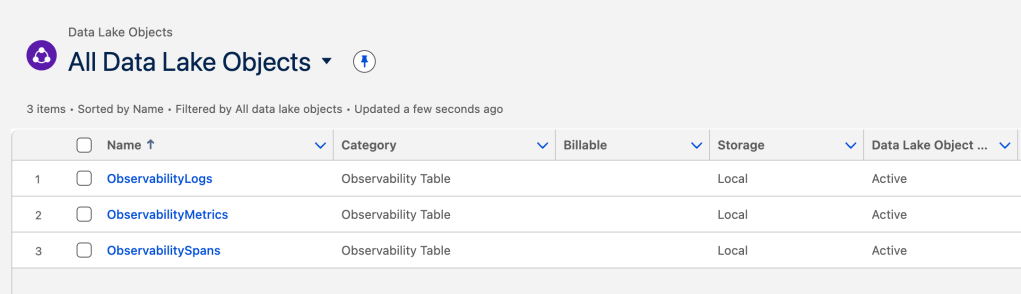
- Immutable and scalable storage: These DLOs act as read-only, append-only tables that ensure immutable and highly scalable data storage, which is essential for handling high-velocity telemetry. The data is effectively partitioned by timestamp, allowing for highly optimized, time-bound queries when your teams need to investigate issues
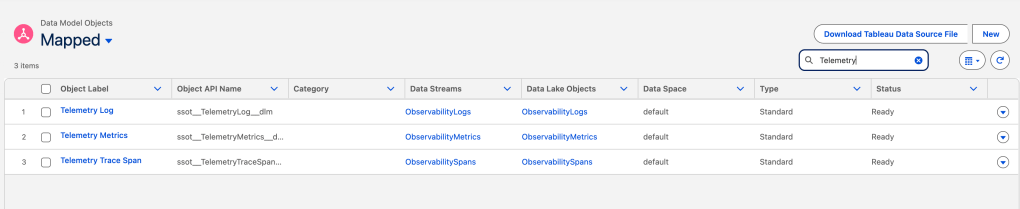
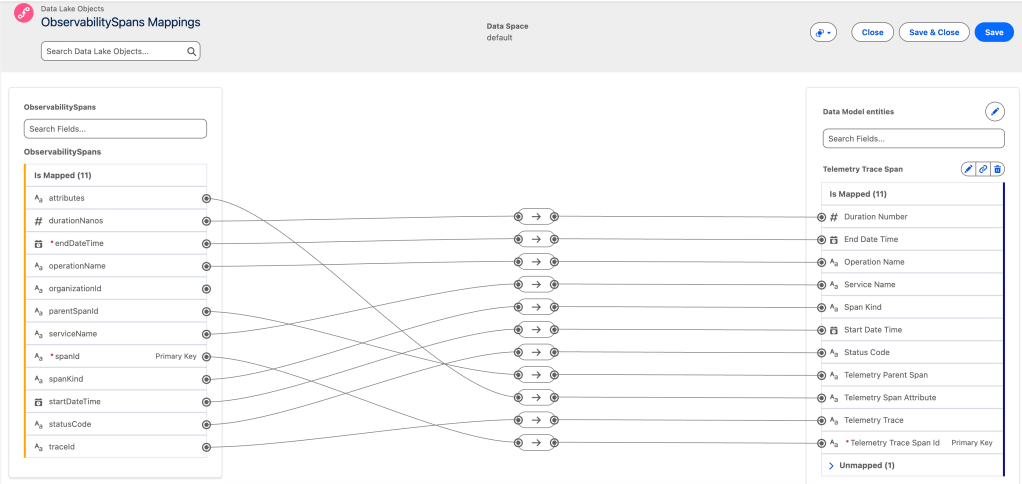
- Mapping for analytics (DMOs): Beyond simple storage, Data Cloud automatically maps these DLOs to corresponding Data Model Objects (DMOs), such as the Telemetry Log, Telemetry Metrics, and Telemetry Traces Span. This automated mapping creates a highly organized foundation that supports complex analytics
Frictionless setup and Seamless Sign-On (SSO)
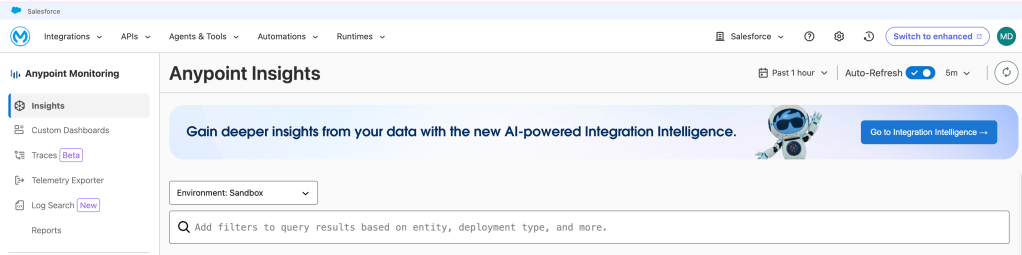
- Establishing Cloud-to-Cloud (C2C) Trust: Setting up this powerful integration intelligence requires minimal administrative overhead for your teams. Your Salesforce and MuleSoft Administrators can easily establish Cloud-to-Cloud (C2C) trust between a Salesforce Org and Anypoint Platform by sharing your tenant key
- Seamless Sign-On: Once the foundational trust is established, your developers experience the magic of Seamless Sign-On (SSO). By enabling this feature, Anypoint Platform users can automatically authenticate into the Salesforce Integration Lightning App using their existing Anypoint credentials, eliminating the need to juggle separate logins or navigate disconnected interfaces
Automated workspace provisioning
By simply enabling telemetry ingestion and following click through installation prompts, the system automatically creates the necessary Data Cloud Connections, Data Streams, DLO <-> DMO Mapping and Tableau dashboards in your designated dataspace. This automated workspace provisioning eliminates tedious manual configuration steps, accelerating your time to value.
Empowering DevOps and integration architects
- Out-of-the-Box visualization: By leveraging out-of-the-box Tableau Next dashboards, your DevOps engineers and Integration Architects gain immediate, actionable insights into application health and resource consumption. These pre-built dashboards allow you to proactively monitor API performance, track error rates, and analyze metrics across your entire deployment landscape
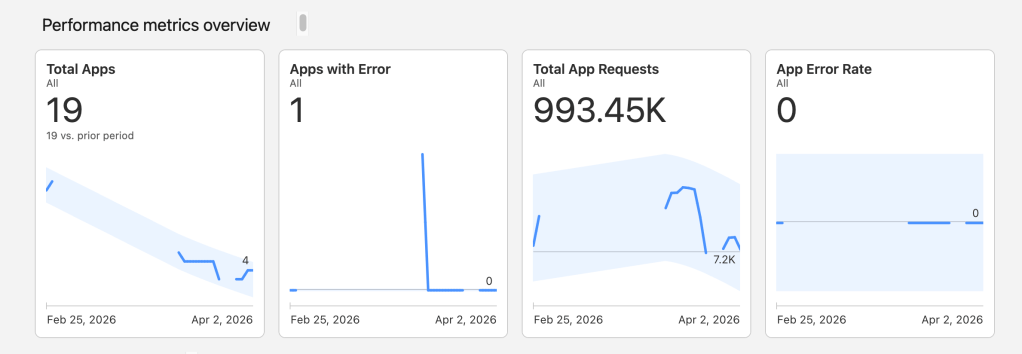
- Context-rich correlation: When latency bottlenecks or errors inevitably occur, your teams need context fast. The platform solves this by automatically connecting discrete data points, correlating your logs with distributed traces using unique Trace IDs and Span IDs
- Rapid root cause analysis: If an application experiences a critical failure, your developers can drill down into a specific, slow-performing trace span and instantly view the exact log entries generated during that millisecond. This unified, context-rich troubleshooting experience drastically reduces mean time to resolution (MTTR)
Strict data segregation and governance
- Internal vs. external spans: Security and privacy are deliberately woven into the architectural fabric of i360 Integration Intelligence. The platform explicitly separates “internal system spans” used by internal engineers from the “customer-facing external spans” designed for your end-users
- Protecting PII and infrastructure: This strict data segregation ensures that your business-sensitive customer prompts and Personally Identifiable Information (PII) are completely shielded from internal Salesforce staff. Conversely, this barrier prevents internal infrastructure and code details from leaking to your customers, effectively mitigating potential compliance risks
- Role-Based Access Control (AuthZ): Telemetry data visibility is heavily controlled by robust Role-Based Access Control (AuthZ) mechanisms. Your users must possess specific permissions, like the “Monitoring Viewer Permission,” to view spans from different services, and all trace data is strictly isolated within your organization’s boundary
Eliminate silos with i360 Integration Intelligence
By converging MuleSoft telemetry with Salesforce Data Cloud, i360 Integration Intelligence eliminates the observability silos that have historically plagued complex integrations. It empowers your integration developers and administrators with a holistic, context-rich view of your entire landscape while enforcing strict data governance. This unified approach not only accelerates error diagnosis but fundamentally transforms how you manage and optimize your digital ecosystems.


