
Modern integration platforms are constantly evolving. New Java and Mule Runtime versions deliver security, performance, and platform improvements—but keeping thousands of Mule applications current has operational cost.
The process can span multiple steps: assessing application dependencies, checking connector compatibility, updating build configuration, making code changes, and repeatedly testing and troubleshooting.
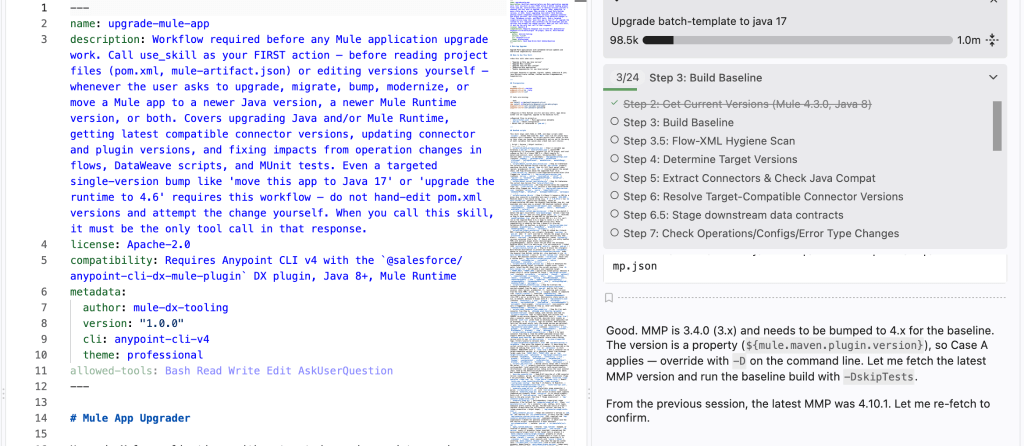
MuleSoft Vibes brings an agentic AI approach to this challenge,transforming Java and Mule Runtime upgrades from a manual, multi-step process into an intelligent, guided workflow. With a Skill-based approach for MuleSoft Vibes, one can leverage this capability in any agentic coding tool – including Claude Code, Windsurf, GitHub Copilot, Codex, and Cursor.
From 20+ Manual Steps to an Agentic Upgrade Experience
Today, developers may need to manually identify application dependencies, assess connector compatibility, update project and Maven configurations, make code changes, and repeatedly build and test the application.
MuleSoft Vibes manages these activities through an agentic workflow:
Discover → Assess → Upgrade → Build → Fix → Test → Validate
Vibes analyzes the application, understands its dependencies, determines compatibility with the target Java and Mule Runtime versions, and recommends the changes required to move forward.
Instead of developers coordinating dozens of individual upgrade activities, Vibes can take on the repetitive work and guide the application through the modernization process.
Vibes Doesn’t Stop at Version Updates
Changing version numbers is only the beginning of an upgrade.The real challenge starts when the application is rebuilt and something breaks: connector may no longer be compatible, an operation may have changed, or an application flow may require modification.
MuleSoft Vibes uses its agentic capabilities and skills to analyze these errors and make the necessary changes—continuing the cycle until the application builds successfully, then running MUnit tests and addressing any failures.
This shifts the experience from developers manually troubleshooting every issue to an agent that can progressively identify and remediate upgrade-related problems.
Understanding Enterprise Dependencies
Many organizations use shared parent POMs to standardize connector and library versions across their Mule applications.This adds another layer of complexity because an application may depend on versions managed outside the application itself.
The upgrade skill can understand these relationships and help developers determine which dependencies need to change. It can recommend updating only impacted dependencies or provide the option to update a broader set of dependencies.This lets organizations maintain their existing development standards while reducing the manual effort required to perform upgrades.
Human-in-the-Loop by Design
Agentic automation should not mean uncontrolled automation.Enterprise upgrades can have significant production implications, so developers need visibility and control over important decisions. The skill can therefore include confirmation points for decisions such as target Java and Mule Runtime versions, connector upgrades, and dependency changes.
The agent handles the tedious analysis and implementation work, while the developer stays in control of consequential decisions.
From Upgrade Projects to Continuous Modernization
Rather than treating Java and Mule Runtime upgrades as large, periodic projects involving dozens of manual steps, organizations can use MuleSoft Vibes to make modernization a continuous, increasingly automated experience.
The developer experience can be simple: select the target Java and Mule Runtime versions, invoke the upgrade skill, and let the agent manage the analysis, dependency updates, remediation, builds, and tests.
The developer moves from managing the upgrade process to supervising the upgrade outcome.
To learn more about MuleSoft Vibes visit our documentation here. You can also learn more about MuleSoft Skills here


